


Introduction
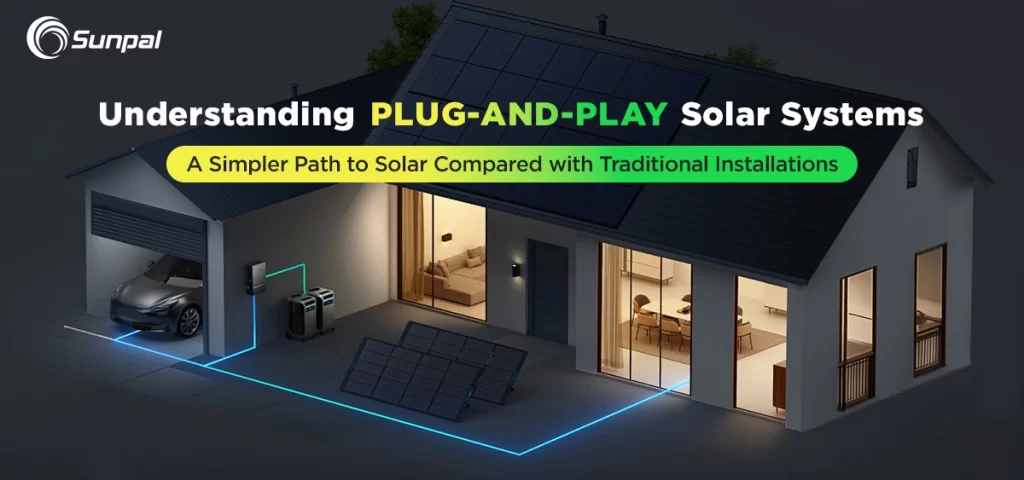
Alors que le gouvernement britannique accélère ses plans de formalisation de la réglementation des kits solaires "plug-and-play" dans les mois à venir, les foyers du pays ont accès à une manière révolutionnaire de produire de l'énergie propre. La récente consultation du DESNZ et les mises à jour associées signalent une étape majeure vers la simplification de l'énergie solaire à petite échelle, la rendant aussi simple que de brancher un appareil ménager.
Les kits solaires plug-and-play au Royaume-Uni sont des systèmes compacts qui permettent aux utilisateurs ordinaires de produire de l'énergie solaire sans la complexité, le coût ou les perturbations associés aux installations traditionnelles. Ces kits comprennent généralement des panneaux solaires associés à un micro-onduleur, permettant une connexion directe à une prise murale standard. Cette évolution est particulièrement importante pour les locataires, les propriétaires d'appartements et ceux qui ne peuvent pas investir dans des systèmes de toiture complets, car elle abaisse les barrières financières et techniques tout en soutenant les ambitions nettes zéro de la nation.
Dans ce guide approfondi, nous explorons ce que sont les kits solaires plug-and-play, leur fonctionnement et, plus important encore, en quoi ils diffèrent des systèmes solaires traditionnels. Nous examinons le cadre réglementaire actuel au Royaume-Uni, les avantages clés, les composants essentiels, les considérations pratiques et les opportunités futures. Que vous soyez un propriétaire évaluant vos options, un locataire recherchant des solutions énergétiques abordables, un distributeur explorant de nouveaux marchés ou un installateur se préparant à la demande, cet article vous fournit les éclaircissements nécessaires pour prendre des décisions éclairées.
Qu'est-ce qu'un kit solaire Plug-and-Play ?
Un kit solaire plug-and-play, souvent appelé solaire enfichable ou solaire de balcon, est un système photovoltaïque à petite échelle, prêt à l'emploi, conçu pour une autoinstallation simple et une connexion immédiate au réseau. Contrairement aux installations conventionnelles nécessitant des travaux électriques importants, ces kits sont conçus pour se connecter directement via une prise britannique standard BS 1363, rendant l'énergie solaire accessible à un public plus large.
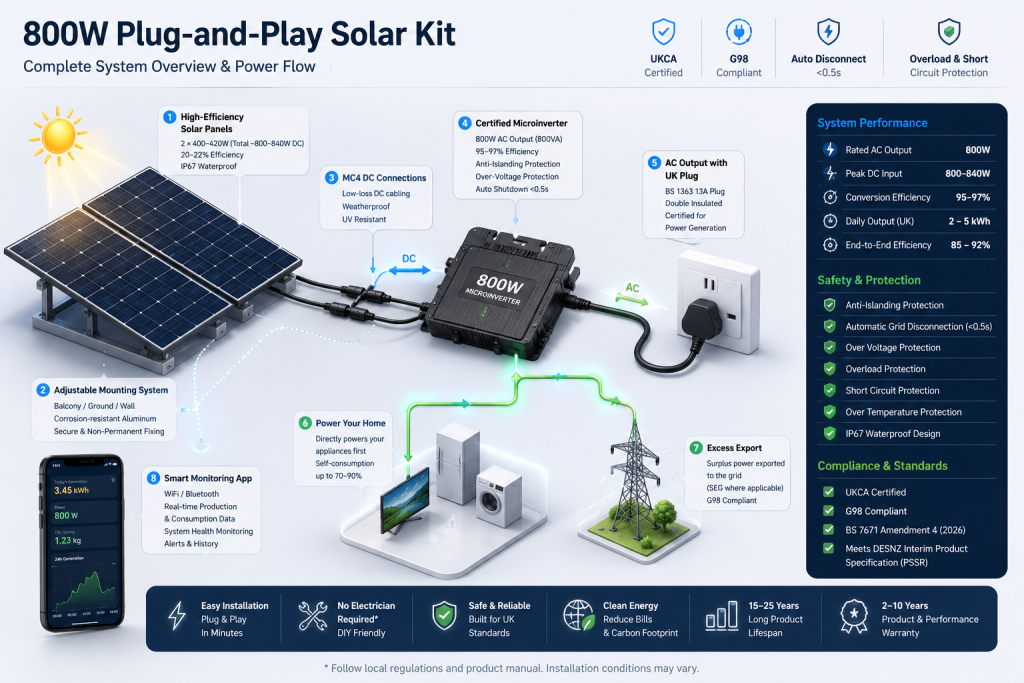
Dans leur essence, ces kits se composent de un ou plusieurs panneaux solaires à haut rendement, un micro-onduleur raccordé au réseau, le matériel de montage et les câbles de connexion. Le micro-onduleur convertit le courant continu (CC) généré par les panneaux en courant alternatif (CA) qui correspond aux besoins du foyer. Une fois branché, le système privilégie l'électricité solaire pour faire fonctionner les appareils, réduisant ainsi la consommation du réseau et ralentissant le compteur électrique.
Les systèmes typiques ciblent des sorties allant jusqu'à environ 800W AC, conformément aux limites de sécurité proposées au Royaume-Uni. Dans les conditions britanniques, un kit de 800W peut produire entre 650 et 900 kWh par an dans les régions du sud, avec des chiffres légèrement inférieurs plus au nord. Cette production est suffisante pour compenser une part importante de la consommation de base des appareils toujours allumés tels que les réfrigérateurs, les routeurs et les appareils électroniques en veille.
Comment le système fonctionne étape par étape :
- La lumière du soleil frappe les panneaux, produisant ainsi du courant continu.
- Le micro-onduleur gère la conversion en courant alternatif tout en intégrant des fonctions de sécurité essentielles comme la protection anti-îlotage.
- Le courant pénètre dans le circuit domestique, où les appareils connectés le consomment préférentiellement.
- Tout surplus peut être exporté vers le réseau dans le cadre d'arrangements conformes, sous réserve de notification G98.
Développements réglementaires actuels, notamment BS 7671 Amendement 4 et en cours Consultation sur la spécification produit temporaire du DESNZ (clôture le 30 juin 2026), établissent des normes de sécurité claires. Les kits conformes doivent porter le marquage UKCA, être équipés de micro-onduleurs certifiés et disposer d'un système d'arrêt automatique en cas de coupure de courant afin de protéger les techniciens de maintenance.
Ces systèmes sont particulièrement intéressants car ils ne nécessitent aucune modification structurelle permanente. Ils peuvent être fixés sur des balustrades de balcon, des structures de jardin ou des supports muraux, ce qui permet de les déplacer facilement. Cette portabilité et cette simplicité distinguent les kits « plug-and-play » des installations traditionnelles plus rigides, ce qui en fait une solution énergétique complémentaire idéale pour la vie moderne.
Flux de puissance kit solaire plug-and-play
Du soleil aux factures d'électricité réduites
Systèmes solaires enfichables (Plug-and-Play) vs. Systèmes solaires traditionnels : une comparaison détaillée
Comprendre les différences entre les kits solaires « plug-and-play » et les systèmes traditionnels installés sur les toits aide les utilisateurs potentiels à choisir l'option la mieux adaptée à leur situation. Ces deux approches répondent à des besoins différents et présentent des compromis évidents en matière d'installation, de coût, de performances et d'application.
Installation et accessibilité
Les kits prêts à l'emploi excellent en matière de simplicité et d'accessibilité. Les utilisateurs peuvent généralement terminer l'installation en moins d'une heure en utilisant des outils de base, voire aucun outil. Les systèmes sont portables et non permanents, ce qui les rend adaptés aux locataires qui pourraient avoir besoin d'emporter leur investissement lors d'un déménagement. Les installations sur balcon, patio ou au sol nécessitent des autorisations minimales au-delà du consentement du propriétaire dans les propriétés locatives.
En revanche, les systèmes solaires traditionnels exigent une installation professionnelle par des techniciens certifiés MCS. Cela implique des relevés de toiture, un échafaudage, une intégration électrique dans le tableau de distribution et potentiellement des autorisations d'urbanisme. Le processus peut prendre des semaines et entraîne des coûts de main-d'œuvre importants, bien qu'il en résulte un système plus intégré, de plus grande capacité, optimisé pour des performances à long terme.
Coût et échelle
L'investissement initial est l'un des plus grands avantages du "plug-and-play". Un kit typique de 600 à 800W coûte entre 400 et 1 000 £, tous les composants compris. Systèmes traditionnels de 3,5 à 6 kW sur toiture Leur prix varie généralement entre 5 000 et 15 000 £, voire plus, selon la présence ou non d’une batterie et la complexité de l’installation. Cet écart de prix fait des systèmes « plug-and-play » une solution d’essai attrayante et peu risquée pour les novices en matière d’énergie solaire ou les foyers disposant d’un budget limité.
Puissance, Performances et Économies
La capacité de production met en évidence une autre différence majeure. Les kits "plug-and-play" sont limités en termes d'échelle et donc en génération totale. Un système de 800W pourrait produire entre 650 et 900 kWh par an dans des emplacements optimaux du sud du Royaume-Uni, ce qui se traduirait par des économies annuelles de 70 à 180 £ aux tarifs d'électricité actuels (environ 24 à 28p/kWh), en fonction des taux d'autoconsommation et de la qualité de l'installation.
Les installations traditionnelles, dotées de panneaux beaucoup plus nombreux et mieux optimisées (toits orientés vers le sud avec des angles idéaux), produisent généralement entre 3 000 et 5 000 kWh par an. Combinés aux versements au titre du programme « Smart Export Guarantee », les bénéfices financiers annuels atteignent souvent entre 500 et 975 £, voire plus, notamment lorsqu'ils sont associés à des batteries domestiques permettant d'augmenter l'autoconsommation.
Exigences réglementaires et de conformité
Le plug-and-play suit un chemin simplifié. Une fois que le spécification produit provisoire est finalisé, les kits conformes nécessiteront uniquement une notification G98 simplifiée. Les dispositifs de sécurité sont intégrés principalement dans le micro-onduleur certifié et la conception globale du kit.
Les installations traditionnelles impliquent des processus G98 ou G99 plus complets, des certifications électriques détaillées et souvent des préapprobations de la DNO pour les systèmes plus importants. Bien que plus rigoureux, ces éléments garantissent une intégration transparente et des capacités d'exportation plus élevées.
Cas d'utilisation et longévité
Les solutions "plug-and-play" conviennent le mieux aux locataires, aux citadins vivant en appartement, aux foyers dont le toit n'est pas adapté, ou à ceux qui recherchent un système d'appoint. Leur nature modulaire permet une expansion progressive dans certains cas. Les panneaux solaires traditionnels sur toiture conviennent aux propriétaires disposant d'un espace de toiture adéquat et qui souhaitent une indépendance énergétique maximale et des rendements à long terme. La durée de vie des panneaux est comparable (plus de 25 ans), mais les systèmes traditionnels incluent souvent des garanties plus solides sur les composants intégrés.
Tableau de comparaison visuelle :
| Aspect | Plug-and-Play (≤800W) | Toiture traditionnelle (3,5 kW+) |
| Temps d'installation | Minutes en heures (Bricolage) | Jours en semaines (professionnel) |
| Coût initial | 400 à 1 000 £ | 5 000 à 15 000 £ et plus |
| Production annuelle | 500–900 kWh | 3 000 à 5 000+ kWh |
| Économies annuelles | 70 £ à 180 £ | 500 £-975 £+ |
| Période de récupération | 3–6 ans | 6–15 ans |
| Utilisateurs Idéaux | Locataires, propriétaires d'appartements | Propriétaires avec accès au toit |
| Évolutivité | Limitée | Haut |
| Intégration de la batterie | Restreint dans les kits de base | Direct |
Projection d'épargne sur 15 ans
Systèmes solaires Plug-and-Play vs traditionnels dans les régions du Royaume-Uni (estimations de 2026)
Hypothèses clés
Dans l'ensemble, le plug-and-play privilégie la commodité et les faibles barrières à l'entrée, tandis que les systèmes traditionnels offrent une évolutivité supérieure et une valeur à long terme. De nombreux utilisateurs pourraient éventuellement combiner les deux approches à mesure que la réglementation et la technologie évoluent.
Le paysage réglementaire britannique et les développements récents
Le chemin vers l'adoption généralisée du solaire "plug-and-play" au Royaume-Uni a impliqué une évolution réglementaire prudente axée sur la sécurité et la praticité. Historiquement, les règles sous BS 7671 et les règlements sur les fiches et prises (Sécurité) empêchaient la connexion directe d'équipements de production aux prises en raison de risques tels que l'isolement involontaire ou la surcharge des circuits.
L'élan s'est construit début 2026 avec des annonces gouvernementales visant la légalisation dans les mois qui suivent. La BS 7671, amendement 4, a créé un cadre dédié pour les petits systèmes de prosommateurs jusqu'à 800W. Le Département de la sécurité énergétique et du zéro émission nette a ouvert une consultation clé en juin 2026 proposant des amendements au PSSR et introduisant une spécification de produit intérimaire. Cette consultation se termine le 30 juin 2026, les réponses devant éclairer les règles définitives peu de temps après.
Le cahier des charges provisoire définit des exigences strictes : sortie maximale de 800 VA, certification UKCA, micro-onduleurs certifiés avec fonctions de protection du réseau, et directives d'installation claires. Les batteries sont généralement exclues des configurations de base enfichables pendant la période de transition afin de simplifier le contrôle de la sécurité. Les systèmes doivent cesser automatiquement d'exporter de l'énergie lors des coupures du réseau.
Ce cadre équilibre innovation et protection. Il permet une notification G98 “ adaptée et informative ” pour les kits conformes tout en maintenant des normes élevées. La politique s'inscrit dans des stratégies plus larges de neutralité carbone et de sécurité énergétique, visant à encourager la production décentralisée des ménages que le solaire traditionnel ne peut pas atteindre facilement.
Pour les distributeurs et les installateurs, ces changements ouvrent d'importantes nouvelles sources de revenus. Une préparation précoce avec des produits prêts pour le marquage UKCA et une éducation des clients seront avantageuses à mesure que les kits certifiés arriveront sur le marché. Les composants de Sunpal sont alignés sur ces normes émergentes, soutenant ainsi les partenaires tout au long de la transition.
Feuille de route réglementaire sur le solaire Plug-and-Play au Royaume-Uni 2026
De l'annonce à la disponibilité générale sur le marché
Annonce gouvernementale
TerminéBS 7671 Amendement 4
TerminéLa consultation DESNZ est ouverte
Phase critiqueClôture de la consultation
Aujourd'huiRéponses publiées
AttenduRègles techniques finalisées
Impact très élevéPremiers kits disponibles
Lancement sur le marchéDate limite de conformité
ObligatoireNorme BSI complète
AttenduAdoption massive
Phase de croissanceJalons terminés
Les annonces gouvernementales et les mises à jour BS 7671 ont établi la base légale pour le solaire enfichable.
Mise au point actuelle
La consultation et les spécifications de sécurité du DESNZ déterminent le cadre final du marché.
Phase de lancement sur le marché
Les produits certifiés devraient être livrés aux détaillants pendant l'été et l'automne 2026.
Avantages clés des kits solaires prêts à l'emploi
Les avantages du solaire prêts à l'emploi vont au-delà de la simple commodité. Pour de nombreux utilisateurs, ces kits constituent la voie la plus pratique pour une participation immédiate aux énergies renouvelables.
Économies financières et retour sur investissement
Réaliste les économies annuelles varient de 70 £ à 180 £ pour un système de 800 W, en fonction de l'emplacement, de l'orientation et des habitudes de consommation. Avec des prix de kit d'environ 400 à 1 000 £, des périodes de récupération de 3 à 6 ans sont réalisables. Sur une durée de vie des panneaux de 15 à 25 ans, les économies nettes peuvent s'accumuler de manière significative après la période de récupération initiale, offrant une protection contre les futures augmentations des prix de l'électricité.
Accessibilité améliorée
Ces kits permettent aux locataires (environ 36% de foyers britanniques), aux résidents d'immeubles et aux propriétaires dont les toits ne se prêtent pas à l'installation de panneaux solaires de devenir propriétaires d'une installation solaire. Leur conception amovible et leurs exigences d'installation minimales permettent de surmonter les obstacles habituels. De nombreux utilisateurs se déclarent très satisfaits de pouvoir produire de l'électricité immédiatement, sans avoir à effectuer de travaux importants dans leur logement.
Contributions environnementales
Chaque kit de 800W peut éviter 70 à 150 kg d'émissions de CO₂ par an. À grande échelle, une adoption généralisée soutient les objectifs nationaux de réduction du carbone et diminue la dépendance à la production centralisée de combustibles fossiles.
Flexibilité et avantages supplémentaires
La portabilité permet aux utilisateurs d'optimiser l'emplacement selon les saisons ou de déménager entièrement. Les systèmes s'intègrent bien aux applications de surveillance de l'énergie pour des informations en temps réel. Lorsqu'ils sont combinés à des solutions complémentaires telles que le stockage LiFePO4 de haute qualité auprès de fournisseurs tels que Sunpal, les utilisateurs gagnent en indépendance, même si les règles de base de branchement limitent la connexion directe de la batterie.
Bénéfices Sociétaux Plus Larges
L'augmentation de la production distribuée renforce la résilience du réseau et soutient la sécurité énergétique. La technologie encourage une plus grande participation du public aux énergies renouvelables, favorisant ainsi une culture de durabilité.
Composants Essentiels et Critères de Sélection
Les performances réussies en mode plug-and-play dépendent de composants de qualité fonctionnant ensemble de manière transparente. Les éléments clés comprennent des panneaux solaires à haut rendement (généralement monocristallins de 400W+), un micro-onduleur fiable avec les protections essentielles, des systèmes de montage robustes mais légers, et des câbles certifiés avec les connecteurs appropriés.
Lors de la sélection d'un kit, privilégiez la certification UKCA, la conformité G98 et des dispositifs de sécurité éprouvés comme la déconnexion automatique. Les micro-onduleurs sont particulièrement critiques : ils gèrent la conversion, l'optimisation et la synchronisation avec le réseau pour chaque panneau ou paire. Recherchez des garanties solides : plus de 25 ans sur les panneaux et plus de 10 ans sur les onduleurs.
Sunpal propose des panneaux à haut rendement et micro-onduleurs spécifiquement adaptés aux configurations "plug-and-play" britanniques. Ces composants mettent l'accent sur la durabilité par temps variable, une efficacité de conversion élevée et la conformité aux normes émergentes, ce qui les rend idéaux pour les utilisateurs finaux comme pour les partenaires B2B qui configurent des kits complets.
Des considérations supplémentaires incluent les capacités de surveillance via des applications, la facilité d'extension et le support des fournisseurs pour les questions techniques ou les garanties. Choisir des partenaires réputés garantit la fiabilité à long terme et la tranquillité d'esprit.
Considérations pratiques, défis et meilleures pratiques
Bien que les systèmes solaires « plug-and-play » soient faciles à utiliser, l’obtention de résultats optimaux nécessite de prêter attention aux détails. L’emplacement influe considérablement sur le rendement : une orientation vers le sud à un angle de 30 à 40° offre les meilleurs résultats, tandis que l’ombrage ou des angles sous-optimaux peuvent réduire la production de 30 à 60%. Compte tenu de la variabilité climatique au Royaume-Uni, les systèmes fonctionnent bien même sous une lumière diffuse, mais les utilisateurs doivent surveiller leur fonctionnement via des applications et adapter leurs habitudes d’utilisation (par exemple, en faisant fonctionner les gros appareils électroménagers en milieu de journée) afin de maximiser l’autoconsommation.
La conformité réglementaire demeure essentielle. Même après la légalisation complète, notification G98 votre DNO est généralement requis. Pendant la transition actuelle, certaines installations peuvent encore nécessiter un câblage électrique jusqu'à ce que des kits certifiés prêts à brancher soient largement disponibles.
Les défis incluent une production totale limitée par rapport aux systèmes complets, des restrictions d'exportation potentielles dans les configurations de base et la courbe d'apprentissage pour maximiser les avantages. La maintenance est faible : un nettoyage périodique et des inspections visuelles suffisent.
Meilleures pratiques :
- Utilisez des calculateurs spécifiques au code postal pour des projections réalistes.
- Sécurisez les consentements nécessaires pour les propriétés louées ou partagées.
- Combiner avec des mesures d'efficacité énergétique pour des économies amplifiées.
- Sélectionnez des kits auprès de fournisseurs préparés pour la conformité totale à la norme UKCA, tels que Sunpal.
Opportunités de marché et perspectives d'avenir
Le segment plug-and-play au Royaume-Uni est promis à une forte croissance, reflétant les lancements réussis en Allemagne et sur d'autres marchés européens. Les distributeurs, les installateurs et les détaillants ont des opportunités de capter la demande par l'éducation, des ensembles de produits conformes et des services à valeur ajoutée tels que la consultation ou la mise en place de la surveillance.
Sunpal soutient ce marché avec des panneaux de haute qualité, des micro-onduleurs et des kits configurables, ainsi que des ressources pour les partenaires, notamment des conseils de conformité et des conditions B2B compétitives. À mesure que les réglementations se finalisent et que la sensibilisation des consommateurs augmente, le secteur connaîtra probablement des innovations dans les solutions de surveillance, les solutions hybrides et les options de stockage intégrées.
Conclusion
Les kits solaires plug-and-play offrent une voie pratique et accessible vers les énergies renouvelables qui complète plutôt que remplace les systèmes traditionnels. Leur simplicité, leur accessibilité et leur adaptation à diverses situations de vie en font un ajout bienvenu au paysage énergétique britannique à mesure que la réglementation progresse.
En comprenant la technologie, les différences avec le solaire de toiture et les exigences de conformité, les utilisateurs et les entreprises peuvent faire des choix éclairés. Sunpal reste engagé à fournir des solutions fiables et conformes à la réglementation qui contribuent à accélérer l'adoption des énergies propres.
Prêt à explorer les options ? Contacter Sunpal pour les détails des kits conformes à l'UKCA, les partenariats de distribution ou des conseils personnalisés. Téléchargez notre guide de marché UK Plug-and-Play pour des informations complètes sur la conformité et les opportunités.
FAQ
1. Les kits solaires prêts à l'emploi sont-ils actuellement légaux au Royaume-Uni ?
Ils progressent rapidement. Les produits conformes respectant le cahier des charges provisoire seront entièrement pris en charge une fois la consultation en cours finalisée.
2. Quelle quantité d'électricité un kit typique génère-t-il ?
Un système de 800 W produit généralement 650 à 900 kWh par an dans le sud du Royaume-Uni, selon l'emplacement et la configuration.
Quelles sont les économies réalistes ?
Prévoyez entre 70 et 180 £ par an, avec un retour sur investissement en 3 à 6 ans pour la plupart des utilisateurs.
4.Les locataires ont-ils besoin d'une autorisation ?
Le consentement du propriétaire est généralement recommandé et souvent requis dans les termes du bail, bien que la possibilité de déplacement aide.
5. Ces kits peuvent-ils inclure des piles ?
Les versions de base des modules d'extension sont limitées selon les propositions actuelles, mais des solutions de stockage compatibles existent pour des configurations améliorées.
6.Comment Sunpal soutient-il ce marché ?
Grâce à des panneaux et des micro-onduleurs performants et respectueux de la conformité, idéaux pour les conditions britanniques et les configurations partenaires.