


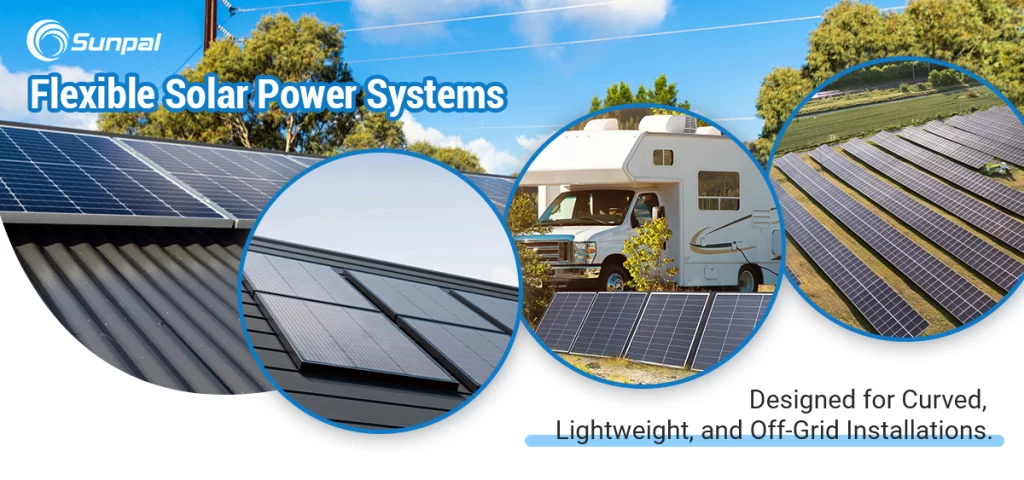
Flexible solar power systems are transforming how clean energy is deployed in real-world scenarios. These lightweight, bendable panels bring solar power to curved, uneven, or weight-sensitive surfaces where traditional rigid panels cannot be installed effectively.
RV owners, boat enthusiasts, off-grid users, and commercial installers are discovering practical advantages that expand solar adoption. This industry overview highlights the key benefits, applications, and data behind flexible solar technology, showing why it represents a growing opportunity in renewable energy.
Understanding Flexible Solar Power Systems
Flexible solar panels consist of thin, high-efficiency solar cells (often monocrystalline or advanced thin-film) sealed in durable, lightweight polymer materials. Unlike heavy glass-covered rigid panels, they are slim (as thin as 2–4 mm), highly bendable (up to 30°–258°), and significantly lighter.
Many premium models achieve efficiencies between 18% and 23%, making them suitable for a wide range of uses. Installation is straightforward — often using adhesive backing — eliminating the need for bulky mounting structures. This versatility makes flexible solar panels an excellent choice for mobile, marine, portable, and specialized installations.
Limitations of Traditional Rigid Solar Panels
Traditional rigid solar panels perform well on flat, structurally sound rooftops and ground-mounted arrays. However, their heavy weight (typically 15–25 kg or more per panel) and inflexible design create challenges on curved roofs, vehicles, boats, or weight-restricted buildings.
These constraints often require costly reinforcements, engineering approvals, or make installation impossible. As a result, many promising solar projects in mobile and specialty segments remain untapped. Flexible solar panels address these issues directly, enabling solar energy on surfaces that were previously out of reach.
Key Applications Unlocked by Flexible Solar Technology
Flexible solar panels excel in several practical areas that align with everyday needs and growing market demand.
RV and Camper Installations
Curved RV roofs and strict weight limits make rigid panels impractical for many owners. Flexible panels conform smoothly to the surface, add meaningful power output (often 200–400W or more), and install quickly without drilling or heavy supports. This supports comfortable off-grid living and appeals to both full-time travelers and weekend adventurers.
Marine and Boat Solutions
Boats and yachts feature curved decks, constant movement, and exposure to moisture. Flexible marine-grade panels bond securely to irregular surfaces, resist vibration and saltwater, and provide reliable power for onboard systems while keeping overall weight low.
Portable and Off-Grid Power
Campers, hikers, emergency responders, and remote workers benefit from lightweight, foldable or rollable panels. These portable solar systems pack easily and deploy rapidly, delivering clean energy for charging devices, running small appliances, or supporting disaster relief efforts.
Electric Vehicles and Automotive Uses
Lightweight flexible panels integrate onto vehicle roofs or other surfaces to provide supplemental charging. The minimal added weight helps preserve efficiency while extending driving range in a convenient, low-profile way.
Commercial and Irregular Roofs
Warehouses, factories, and buildings with curved or weight-limited roofs can now host solar arrays. Flexible panels turn previously unusable space into productive energy-generating areas without major structural modifications.
These applications demonstrate how flexible solar power systems expand access to renewable energy in practical, user-friendly ways.
Data Insights: Performance and Market Trends
Table 1: Flexible vs Traditional Rigid Solar Panels – Detailed Performance Comparison (Based on 2025–2026 Premium Models)
| Feature | Flexible Solar Panels | Traditional Rigid Panels | Key Advantage for Users and Installers |
| Weight (typical 200W) | 4–5 kg (approx. 9–11 lbs) | 15–25 kg (33–55 lbs) or more | 70–80% lighter; no structural upgrades needed; easier transport and handling |
| Flexibility | Bendable up to 258° | Completely rigid (flat only) | Conforms to curved, uneven, or irregular surfaces |
| Efficiency | 18–23% (advanced monocrystalline models reach the higher end) | 20–25% | Close enough for most mobile/portable uses; versatility often outweighs minor difference |
| Installation Method | Adhesive backing or simple mounting (minutes) | Requires racking, bolts, and structural support (hours) | Faster, lower labor cost, no roof penetration in many cases |
| Thickness | 2–4 mm | 30–50 mm or more | Ultra-slim and low-profile design |
| Best Applications | RV, marine, portable/off-grid, EV, irregular commercial roofs | Flat fixed rooftops and ground mounts | Unlocks applications traditional panels cannot serve |
| Typical Lifespan | 10–15 years | 25+ years | Rigid panels last longer; flexible sufficient for mobile uses with proper selection |
| Durability Considerations | Improved UV and weather resistance in modern models; lower hail/wind resistance without protection | Higher resistance to hail, wind, and extreme weather | Flexible panels excel in vibration-prone or curved environments |
This complete table provides a clear side-by-side view of the differences, helping readers understand why flexible solar panels are chosen for specific real-world needs.
Table 2: Projected Global Flexible Solar Panels Market Growth
| Year | Estimated Market Size (USD Million) | Notes / CAGR Insight |
| 2025 | 535–625 | Base year range across multiple reports |
| 2026 | 650–666 | Early growth phase |
| 2030 | 914–950 | Strong momentum from mobile and specialty applications |
| 2032 | 985–1,106 (up to 1,618 in optimistic scenarios) | CAGR approximately 6.7–13.4% depending on segment and source |
(Data synthesized from recent industry analyses, including Allied Market Research, Research and Markets, and other 2025–2026 forecasts. Actual figures vary by methodology, but all indicate consistent upward growth driven by demand in RV, marine, portable, and commercial sectors.)
Table 3: Approximate Application Distribution for Flexible Solar Panels (2025–2026 Trends)
| Application Segment | Estimated Share | Primary Reasons for Adoption |
| RV & Camper Installations | ~40–45% | Curved roofs, weight limits, easy adhesive mounting |
| Marine & Boat Solutions | ~20–25% | Vibration resistance, moisture exposure, curved decks |
| Portable & Off-Grid Power | ~15–20% | Foldable design, rapid deployment for camping and emergencies |
| Automotive / EV Integration | ~8–10% | Lightweight supplemental charging with minimal added weight |
| Commercial & Irregular Roofs + Others | ~5–10% | Weight-restricted or curved buildings; emerging BIPV uses |
These tables present the full data clearly and completely within the article, offering transparent insights without requiring external references.
Balanced Considerations for Flexible Solar Panels
Like any technology, flexible panels have trade-offs. They may experience slightly faster degradation in extreme UV exposure compared to glass-covered rigid panels, and their hail or high-wind resistance can be lower without additional protective measures. Lifespans are often rated at 10–15 years for many models, versus longer for some rigid systems.
However, ongoing advancements in materials, coatings, and cell technology continue to improve durability and performance. Selecting quality products with appropriate warranties helps ensure reliable results tailored to specific environments.
Sunpal's Role in Flexible Solar Innovation
Sunpal offers a range of high-quality flexible solar panels designed for real-world reliability. Our lightweight monocrystalline and durable models provide strong efficiency, excellent flexibility, and straightforward installation for RV, marine, portable, and commercial needs.
With a focus on performance and user-friendly design, Sunpal solutions help individuals and businesses adopt solar energy in situations where traditional panels fall short. Technical support and product options are available to match diverse project requirements.
Looking Ahead: The Expanding Potential of Flexible Solar
Flexible solar power systems are making clean energy more accessible and practical across diverse settings. By overcoming the physical limitations of rigid panels, they enable solar adoption on curved surfaces, mobile platforms, and weight-sensitive structures.
As technology advances and awareness grows, these versatile panels are expected to play an increasingly important role in the broader transition to renewable energy. Whether for personal use on an RV or boat, portable power needs, or commercial installations, flexible solar offers a compelling path forward. For more information on flexible solar panels and how they can benefit your specific application, explore Sunpal's product range or reach out to our team for guidance.