


A properly maintained 48V lithium battery can provide reliable solar energy storage for 10–15 years, with LiFePO4 batteries typically achieving 3,000–6,000 charge cycles depending on operating conditions and usage patterns.-
Battery lifespan is influenced by several key factors, including operating temperature, charging settings, depth of discharge (DoD), Battery Management System (BMS) protection, installation environment, and proper LiFePO4 battery care practices.
Compared with traditional lead-acid batteries, LiFePO4 solar batteries require less maintenance and offer higher efficiency, longer cycle life, and better safety. However, following proper maintenance practices can further improve battery performance, extend service life, and maximize your long-term investment in solar energy storage.
Understanding 48V LiFePO4 Battery Voltage and Cell Configuration
A 48V LiFePO4 battery is typically built with 16 LiFePO4 cells connected in series (16S). Each LiFePO4 cell has a nominal voltage of 3.2V, so a 16S configuration provides a nominal battery voltage of 51.2V (3.2V × 16). When fully charged, each cell reaches 3.65V, resulting in a maximum charging voltage of approximately 58.4V.
Understanding the battery's voltage structure helps ensure proper charger settings, BMS protection, and system compatibility, Understanding the battery's voltage structure helps ensure proper charger settings, BMS protection, and system compatibility. For more details on battery design, voltage configuration, and system optimization, explore our 48V LiFePO4 battery guide.
Recommended 48V LiFePO4 Charging Parameters
| Parameter | Recommended Setting |
|---|---|
| Nominal voltage | 51.2V |
| Maximum charge voltage | 58.4V |
| Float voltage | Around 53.6V |
| Recommended DoD | 80% or less |
| Maximum charging current | 0.5C recommended |
For example, a 100Ah 48V lithium battery typically supports a maximum charging current of around 50A at a 0.5C charging rate.
Maintain the Correct Operating Temperature
Temperature is one of the most important factors affecting lithium battery lifespan and performance. Keeping the battery within a suitable temperature range helps reduce aging, improve efficiency, and ensure safe operation.
Effect of Temperature on Lithium Battery Lifespan
Optimal temperature (around 25°C) delivers the best performance and longest battery life.
✅ Best Performance
Around 25°C
| Temperature | -10°C | 0°C | 25°C | 40°C | 55°C |
|---|---|---|---|---|---|
| Performance | 70% | 85% | 100% | 90% | 70% |
Key Insight: Extreme temperatures (too cold or too hot) can reduce battery lifespan.
Maintaining a moderate temperature around 15°C–30°C is ideal for lithium battery performance.
Recommended Temperature Range Under Different Working Conditions:
| Condition | Recommended Temperature |
|---|---|
| Ideal operating temperature | 15°C–30°C |
| Charging range | 0°C–45°C |
| Discharging range | -20°C–60°C |
| Storage temperature | 10°C–25°C |
High temperatures can accelerate internal chemical reactions, causing faster capacity loss, increased battery aging, and potential safety risks. Avoid installing batteries near heat sources, in direct sunlight, or in poorly ventilated areas.
Low temperatures slow down lithium-ion movement, reducing charging efficiency, increasing internal resistance, and lowering available capacity. Charging lithium batteries below 0°C should be avoided unless the battery has low-temperature charging protection or a self-heating function.
Proper temperature management is essential for extending battery life and maintaining reliable energy storage performance.
Avoid Overcharging and Deep Discharging
Although LiFePO4 batteries are designed for deep cycling, frequent overcharging or deep discharging can accelerate battery aging and reduce overall lifespan.
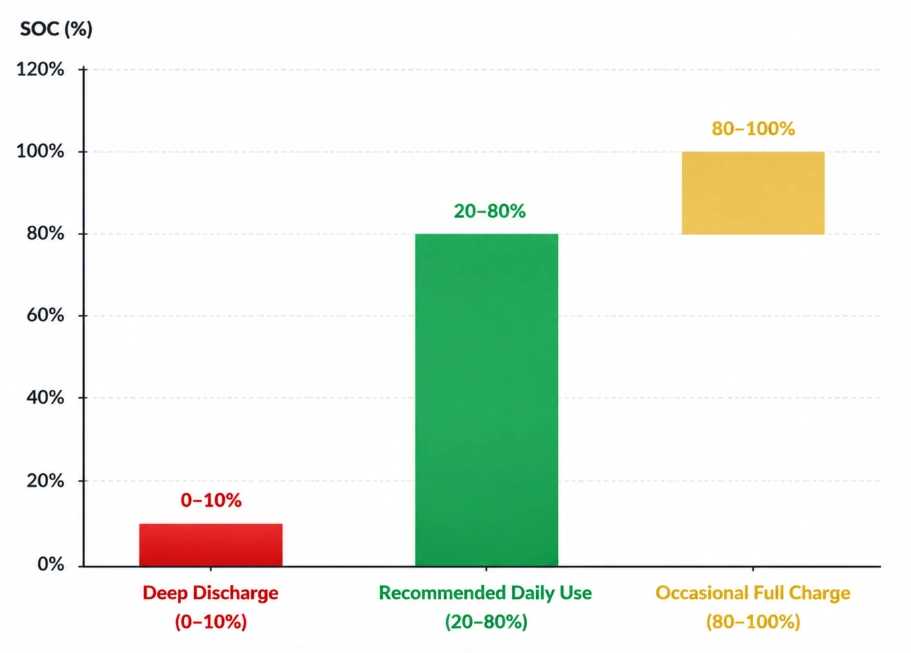
For better battery longevity, it is recommended to maintain the battery State of Charge (SOC) between 20% and 80% during daily operation. Avoid frequent charging to 100% or allowing the battery to completely discharge to 0%.
Recommended LiFePO4 Battery SOC Range:
Deep discharge can cause:
• Cell imbalance
• Reduced usable capacity
• Increased battery stress
A reliable Battery Management System (BMS) helps protect the battery by preventing over-voltage, under-voltage, over-current, and excessive temperature conditions, ensuring safer and more stable long-term operation.
Install the Battery in a Proper Environment
Proper installation conditions play an important role in maintaining lithium battery performance, safety, and service life. A suitable environment helps prevent damage caused by moisture, overheating, and poor ventilation.
Dry Location
Keep batteries away from:
• Rain
• Humidity
• Water leakage
• Condensation
Moisture can damage battery terminals, electronic components, and communication connections.
Good Ventilation
Ensure:
• Enough airflow
• Sufficient space around the battery
• Effective heat dissipation
Avoid:
• Closed cabinets without ventilation
• Crowded installations
Avoid Direct Sunlight
For outdoor installations, use:
• Weatherproof enclosures
• Shade protection
• Thermal management systems
Use Proper Wiring and Connections
Correct wiring is essential for maintaining battery efficiency, safety, and reliable performance. Poor connections or improper cable selection can increase energy losses and create potential safety risks.
Use Correct Cable Size
Avoid undersized cables, which may cause:
• Voltage drop
• Excessive heat
• Energy losses
Keep Cable Length Short
Shorter cables help:
• Reduce resistance
• Improve efficiency
• Minimize voltage losses
Inspect Battery Terminals
Regularly check:
• Tight connections
• No corrosion
• No damaged insulation
• Clean terminals
Loose or damaged connections can lead to:
• Increased electrical resistance
• Heat generation
• Power loss
• Potential safety hazards
Maintain and Configure the Battery Management System (BMS)
The Battery Management System (BMS) acts as the "brain" of a lithium battery system, helping monitor battery conditions and improve safety, efficiency, and lifespan.
Intelligent Control & Configuration of Lithium Battery BMS System
Cell Balancing
Prevents:
• Overcharged cells
• Undercharged cells
• Capacity imbalance
Charge and Discharge Protection
Protects against:
• Overcharging
• Over-discharging
• Excessive current
• Short circuits
Temperature and SOC Monitoring
Tracks:
• Battery temperature
• Charging and discharging status
• Remaining capacity
Fault Alerts
Smart BMS systems provide:
• Warning notifications
• Error records
• Remote monitoring
Avoid Long-Term Storage Without Use
Lithium batteries require proper preparation before long-term storage to prevent capacity loss and performance degradation.
Before Storage
Recommended:
• Keep battery at around 40–60% SOC
• Disconnect unnecessary loads
• Store in a dry environment
• Check battery voltage every 3–6 months
Avoid:
• Leaving the battery completely discharged
• Keeping the battery at 100% charge for months
• Storing in extreme temperatures
Protect Against Sudden Power Surges
High-power appliances can create sudden surge currents that may stress the battery and affect performance.
Common examples:
• Air conditioners
• Water pumps
• Motors
• Compressors
Large surge currents can cause:
• Battery cell stress
• BMS protection activation
• Reduced cycle life
Solutions:
• Select a properly sized inverter
• Check peak power requirements
• Avoid continuous overload operation
Keep Firmware and System Settings Updated
Modern lithium battery systems rely on communication between the battery BMS, hybrid inverter, and energy management system.
Firmware issues may lead to:
• Incorrect charging behavior
• Communication errors
• False protection warnings
Recommended:
• Use compatible inverter settings
• Update firmware when required
• Check CAN/RS485 communication protocols
Recommended 48V Lithium Battery Maintenance Schedule
Regular maintenance helps maintain 48V lithium battery performance, safety, and reliability. Simple inspections at the right intervals can help extend solar battery lifespan and prevent potential issues.
LiFePO4 Battery Maintenance Timeline:
| Frequency | Recommended Checks |
|---|---|
| Monthly | Check SOC, review BMS data, monitor temperature, check charging performance |
| Every 3 Months | Inspect terminals, verify charging parameters, check cable connections |
| Yearly | Check installation environment, enclosure condition, inverter compatibility |
Following a regular 48V battery maintenance schedule helps improve system reliability and extend the service life of LiFePO4 solar batteries.
Common Mistakes That Reduce Solar Battery Lifespan
Avoiding common mistakes is just as important as proper maintenance. The following issues can accelerate battery aging, reduce efficiency, and shorten the lifespan of solar energy storage systems.
7 Common Mistakes That Damage Lithium Batteries
Freezing Temp Charging
Excessive Heat Exposure
Wrong Charger Settings
Deep Discharging
Poor Ventilation
Loose Cable Connections
Ignoring BMS Alerts
Most battery lifespan issues are caused by improper charging, temperature management, installation, or operation. Avoiding these mistakes helps keep the battery working safely and efficiently.
Conclusion
Proper maintenance is essential to maximizing the lifespan, safety, and performance of lithium battery systems. By maintaining suitable operating temperatures, using correct charging settings, protecting the battery with an intelligent BMS, and performing regular inspections, users can achieve more reliable and efficient energy storage performance.
As a trusted solar energy solution provider, Sunpal offers advanced LiFePO4 battery storage solutions designed for residential, commercial, and off-grid applications. Combined with proper maintenance practices, Sunpal's lithium battery systems help customers achieve safer operation, longer service life, and reliable energy independence.