





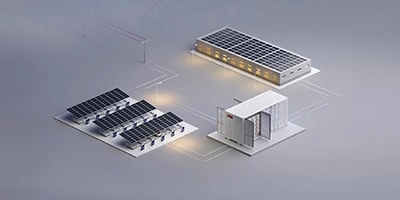

The residential solar market is on the verge of a quiet revolution. In the United Kingdom, the government is preparing to legalize “plug-and-play” solar kits within the coming months—compact systems, typically rated at 800 watts or less, that homeowners can simply plug into a standard household socket. No complex grid applications. No mandatory professional electrician for basic setup. Just safe, certified equipment that begins generating clean power almost immediately.
For solar companies, distributors, and installers, this shift opens a powerful new channel. Traditional rooftop systems remain essential for larger installations, yet they often exclude renters, budget-conscious households, and anyone deterred by high upfront costs or lengthy permitting. Plug-and-play solar kits lower those barriers dramatically. The question is no longer whether demand will appear, but how quickly suppliers can position compliant products and educate the market.
This article explores the opportunity in depth: the policy landscape, the residential customers most likely to buy, the product requirements that matter, and practical strategies for selling plug-and-play solar solutions successfully. Whether you supply UKCA certified solar panels for distributors or assemble complete micro inverter for plug and play system kits, the insights that follow are designed to help you capture share in this emerging segment.
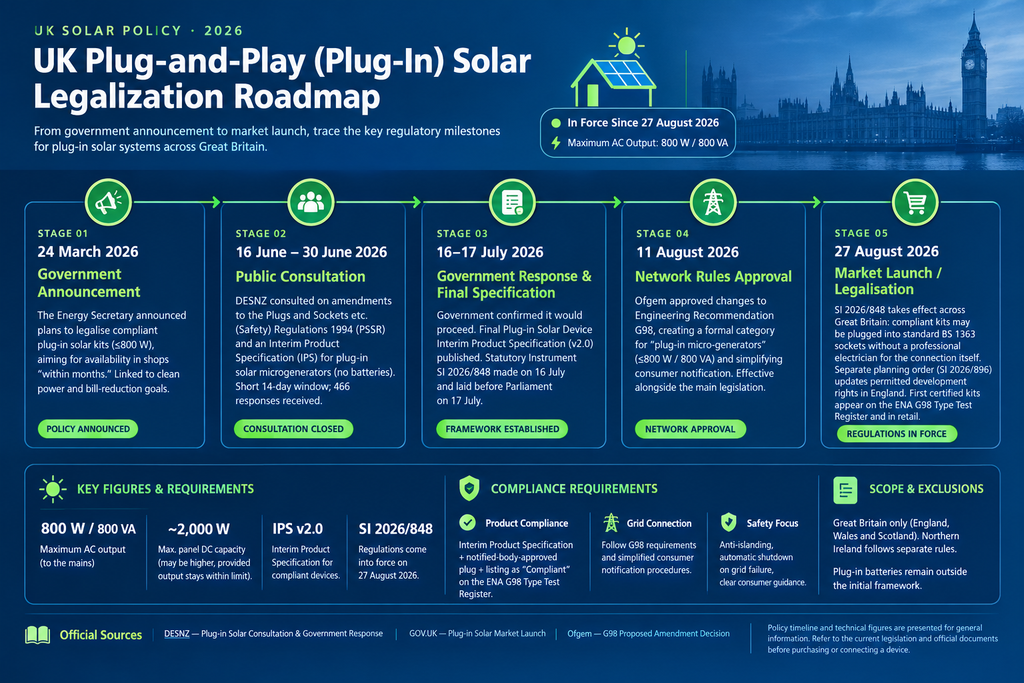
The UK Policy Shift That Changes Everything
The British government has signaled a clear intention: make small-scale solar as accessible as a new kitchen appliance. Under the proposed framework, systems under 800 W that meet strict safety standards will be allowed to connect via a standard three-pin plug. Excess electricity can still be exported, supporting both household savings and broader grid decarbonization.
Safety remains non-negotiable. Every kit must carry UKCA marking, use British-standard plugs, and incorporate certified micro-inverters with anti-islanding protection. When the grid goes down, the system must shut off automatically—protecting utility workers and complying with established grid codes. These requirements create a clear filter: only properly engineered products will reach the market.
For the industry, the implications are immediate. Distributors who stock compliant kits early will be ready the moment regulations take effect. Installers who understand the new rules can offer customers a low-friction entry point into solar. And manufacturers able to supply UKCA solar kit components at scale stand to benefit from a surge in volume orders.
This policy aligns with the UK's net-zero targets and energy-security priorities. By removing friction, policymakers hope to accelerate distributed generation among households previously locked out of the solar transition.
Who Actually Wants These Systems—and Why
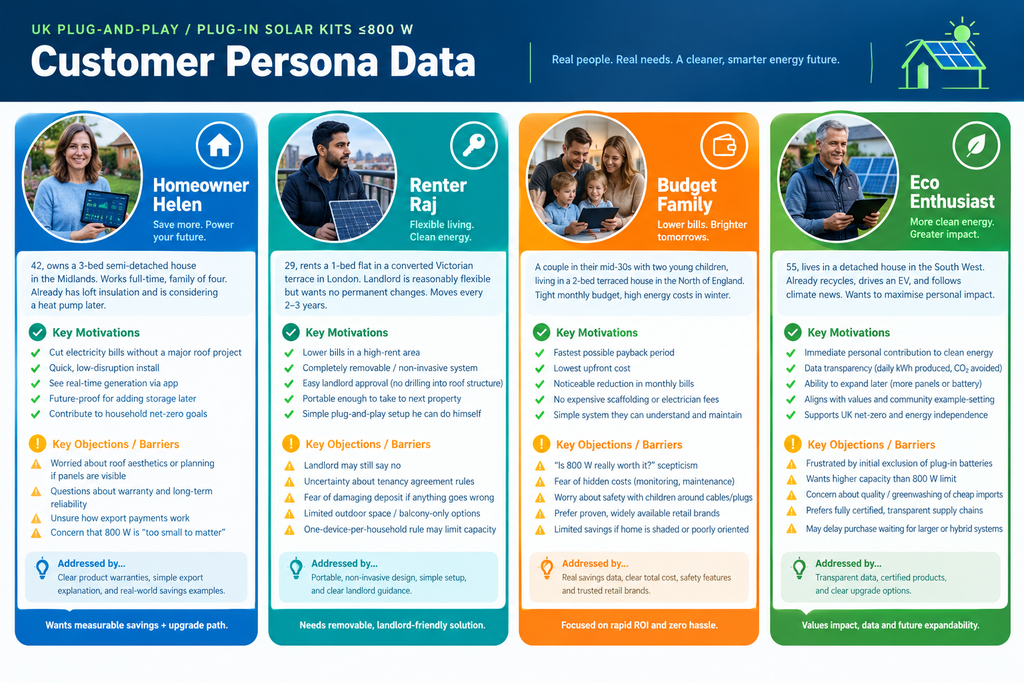
Residential buyers for plug-and-play solar are not identical to traditional solar customers. Many are first-time adopters. Some live in rented properties. Others simply want a faster, lower-commitment way to cut electricity bills.
Four segments stand out:
- Homeowners seeking incremental savings without a full roof redesign.
- Renters who can obtain landlord approval for temporary or non-invasive installations.
- Budget-conscious families focused on rapid payback.
- Environmentally motivated households looking for an easy first step into clean energy.
A solar kit for rented property UK scenarios is particularly interesting. Traditional systems often require structural changes or long-term commitments that landlords resist. Plug-and-play units, by contrast, can be removed when a tenancy ends, making them far more attractive.
End users care about four things above all: proven safety, simple setup, transparent savings, and a clear upgrade path. They want to know the system will not void insurance, will not create fire risks, and will deliver measurable reductions on their energy bills. Smart suppliers equip their channel partners with straightforward ROI tools and plain-language safety explanations.
Designing Kits That Sell: Compliance First, Performance Always
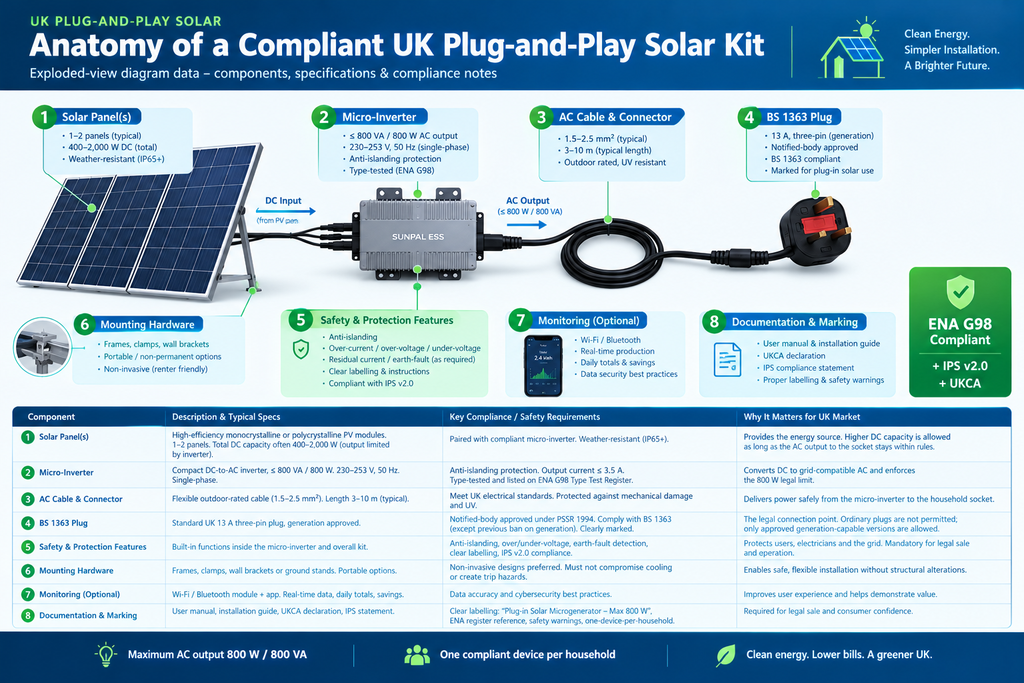
Product quality determines market access. A successful plug and play solar kit UK offering typically includes:
- High-efficiency solar panels sized for systems of 800 W or less.
- A certified micro-inverter engineered for plug-and-play use.
- UKCA-marked plugs and cabling that meet British standards.
- Built-in safety features, especially automatic shutdown on grid failure.
Micro-inverters sit at the heart of these systems. Unlike string inverters, they optimize each panel individually and provide the rapid disconnection required for safety. Distributors should prioritize units explicitly tested for UK grid conditions and clearly labeled for plug-and-play applications.
Optional add-ons strengthen the value proposition. Portable mounting frames increase flexibility for renters or temporary setups. Monitoring apps give users real-time production data. And compact LiFePO4 storage modules allow households to use solar power after sunset—transforming a daytime generator into a more complete energy solution.
Suppliers who can offer pre-configured, fully documented kits reduce friction for their B2B customers. Clear documentation—test reports, UKCA certificates, installation guides—builds trust and shortens sales cycles.
Practical Strategies for Reaching Residential Buyers Through B2B Channels
Selling plug-and-play solar is rarely a direct-to-consumer game for manufacturers. Most volume will flow through distributors, electrical wholesalers, specialist solar installers, and increasingly online retailers. Success depends on making these partners successful.
Position the opportunity clearly
Channel partners need to understand margin potential, ease of sale, and differentiation. Emphasize that these kits open conversations with customers who previously said “solar is too expensive or complicated.” Once trust is established, many of those same customers become candidates for larger systems or storage upgrades.
Equip partners with ready-to-use tools
Provide one-page compliance summaries, sample household savings calculations based on typical UK tariffs and irradiance data, and simple scripts that address common safety questions. A basic online ROI calculator—gated behind an email form—can generate qualified leads for both the distributor and the supplier.
Train the people who talk to end users
Even a short online module covering installation best practices, key safety features, and how to explain export payments can dramatically improve conversion rates. Partners who feel confident sell more confidently.
Price and package intelligently
Transparent kit pricing, volume discounts, and strong warranty support reduce perceived risk. Some suppliers successfully offer “starter” and “plus” versions—the latter including monitoring or a small battery—to increase average order value.
Digital channels matter too. Content that ranks for searches such as “how to sell plug and play solar in uk” or “b2b plug and play solar supplier” attracts serious buyers actively researching the opportunity. Product pages that mention suitability for the emerging UK market, linked to deeper educational articles, improve both visibility and conversion.
Navigating Risks and Building Long-Term Advantage
No new market is without challenges. Regulatory details may still be finalized. Some installers remain cautious about liability. End-user education takes time. Supply of certified components must keep pace with demand.
The most effective response is proactive preparation. Stock only products with full documentation. Maintain open communication with certification bodies and industry associations. Publish clear guidance so channel partners can answer customer questions accurately. And treat early sales not merely as transactions but as opportunities to gather feedback and refine offerings.
Companies that establish themselves as reliable sources of UKCA certified solar panels for distributors and complete compliant kits will find it easier to expand later—into hybrid systems, larger residential packages, or neighboring markets exploring similar simplified rules.
Measuring Progress and Scaling What Works
Track the metrics that matter to both suppliers and partners: kit sell-through rates, average order value, lead-to-sale conversion from educational content, and customer satisfaction scores. Monitor how many basic kit buyers later add storage or upgrade to conventional systems. These data points reveal the true lifetime value of the residential plug-and-play customer.
Early movers can also shape market standards. By publishing transparent performance data and sharing best-practice installation notes, suppliers help raise overall confidence in the category—benefiting everyone while reinforcing their own expertise.
Illustrative projections of cumulative residential plug-and-play solar kits installed in Great Britain following the reported legalisation date of 27 August 2026.
Illustrative Scenarios · Not Official Forecasts- Conservative
- Base
- Optimistic
Desktop: hover over a point. Mobile: tap a point to view its date, scenario, cumulative installations and months since launch.
Slower consumer awareness, supply-chain constraints, landlord resistance and limited retail promotion.
Steady online and retail growth, moderate awareness campaigns and gradual uptake among renters and budget-conscious households.
Strong energy-price pressure, effective retail marketing, wider product availability and rapid consumer adoption.
Retail availability, upfront kit prices, electricity costs, product compliance, landlord approval and consumer confidence could all influence adoption. These are scenario assumptions, not guaranteed outcomes.
Scope: Great Britain — England, Wales and Scotland. Northern Ireland is excluded.
Turning Policy into Profit: The Path Forward
The UK's move toward plug-and-play solar is more than a regulatory tweak. It is a deliberate effort to democratize clean energy generation. For solar professionals, it represents a chance to reach households that traditional systems could not easily serve.
Success will belong to those who combine compliant products with clear education and strong channel support. Focus on safety and certification first. Build kits that are genuinely easy to understand and sell. Arm distributors and installers with the tools they need to convert interest into orders. And stay close to the market as final rules are confirmed.
The window is open now. Companies that act while awareness is rising—before the category becomes crowded—can establish durable positions as trusted suppliers of plug and play solar kit UK solutions.
If you are evaluating how to participate, start by reviewing your current product lineup against UKCA and micro-inverter requirements. Consider developing a dedicated UK-ready kit offering. Create educational assets that answer the questions your B2B customers and their end users are already asking. And explore partnerships that put compliant systems in front of the right residential buyers quickly.
The residential solar market is expanding in new directions. Plug-and-play technology is one of the most accessible paths forward. Those who learn how to sell it effectively will find themselves well positioned for the next phase of distributed clean energy growth.
Ready to explore compliant solutions?
Contact us to get your free UK Plug-and-Play Solar Market Entry Guide, featuring a compliance checklist, target-customer analysis, and practical sales tips. Our team can also help you explore UKCA-ready kits, volume pricing, and partnership opportunities for distributors and installers.
The future of residential solar includes simpler, safer, more inclusive options. The suppliers who help deliver them will lead the way.