


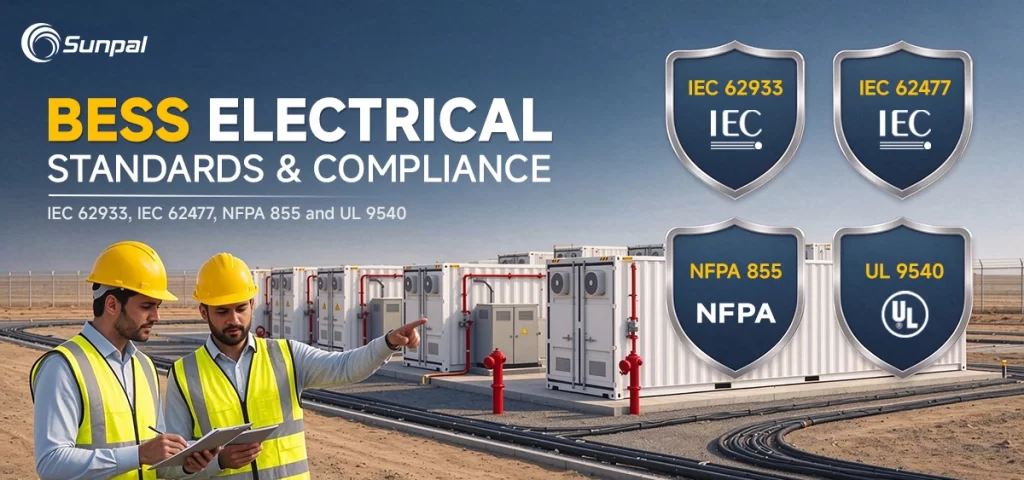
The global push toward clean energy has made battery energy storage systems (BESS) indispensable partners for solar power. As solar farms expand and rooftop solar installations multiply, the ability to store excess daytime generation for evening peaks or cloudy periods has become a cornerstone of reliable renewable energy systems. Yet with this rapid growth come critical questions of safety, performance, and regulatory compliance. Four key standards—IEC 62933, IEC 62477, NFPA 855, and UL 9540—form the backbone of modern BESS electrical requirements. Understanding them is essential for anyone developing, installing, or operating solar-plus-storage projects.
Why BESS Safety Standards Matter More Than Ever in the Solar Era
Solar energy continues to set installation records worldwide, but intermittency remains its biggest challenge. Battery energy storage systems solve that challenge by capturing surplus solar generation and releasing it when the sun is down or demand spikes. Utility-scale BESS, commercial solar battery systems, and residential solar energy storage solutions are now standard features of many new projects.
This growth, however, has highlighted real risks. Thermal runaway in lithium-ion batteries, electrical faults in power conversion systems, and improper installation can lead to fires, equipment damage, or grid instability. Insurers, lenders, and authorities having jurisdiction (AHJs) increasingly demand proof that systems meet recognized standards before approving permits or financing. Compliance is no longer optional—it is a prerequisite for bankable solar-plus-storage projects.
These four standards address different but complementary layers of the BESS value chain: system-level planning and safety (IEC 62933), power electronics (IEC 62477), product certification (UL 9540), and installation practices (NFPA 855). Together they create a robust framework that supports the safe integration of energy storage with solar generation.
IEC 62933: The International Blueprint for Grid-Connected Energy Storage
The IEC 62933 series, developed by IEC Technical Committee 120, provides the most comprehensive international framework for electrical energy storage (EES) systems, including BESS used in solar applications. Rather than a single document, it is a family of standards covering vocabulary, planning, performance assessment, environmental issues, and safety.
IEC 62933-1 establishes shared terminology so engineers, manufacturers, and regulators speak the same language. Planning and performance parts (notably IEC 62933-3-1 and related documents) guide sizing, functional requirements, testing (factory and site acceptance), monitoring, and lifecycle considerations for grid-connected systems—exactly the type used in utility-scale solar farms and large commercial solar-plus-storage installations.
Safety receives particular attention. IEC 62933-5-1 sets general safety considerations for grid-integrated EES, including hazard identification and risk assessment. IEC 62933-5-2 focuses specifically on electrochemical systems and has undergone significant updates. The 2025 edition introduced new BESS energy categories (E-LI for systems integrated within one enclosure and E-LS for multi-enclosure designs), refined location-based risk considerations, and added guidance on reused or repurposed batteries—an increasingly relevant topic as second-life batteries from electric vehicles enter the stationary solar storage market.
For solar developers operating across borders or exporting equipment, IEC 62933 offers a globally recognized pathway. It helps ensure that battery energy storage systems perform reliably when paired with solar inverters and that safety measures address the unique operating profiles of renewable energy integration, such as frequent charge-discharge cycling driven by solar production patterns.
COR1:2019
IEC 62477: Guarding the Power Electronics at the Heart of Solar Storage
Every modern BESS relies on sophisticated power electronic converter systems (PECS) to manage the flow of energy between batteries, the solar array, and the grid. IEC 62477-1:2022 (with subsequent corrigenda) serves as a group safety publication for these converters and related equipment operating at voltages up to 1 000 V AC or 1 500 V DC. A companion part addresses higher voltages.
The standard establishes common terminology and minimum requirements to reduce risks of electric shock, fire, thermal hazards, energy hazards, and mechanical dangers during normal use, operation, and, where specified, service and maintenance. It emphasizes coordination of safety aspects across interrelated parts of a converter system—critical when bidirectional inverters or hybrid solar-plus-storage converters must respond rapidly to changing solar irradiance and load conditions.
In practice, IEC 62477 provides a foundational safety layer for the power conversion systems (PCS) that sit between battery racks and the point of interconnection in solar energy storage projects. Manufacturers of solar inverters and BESS PCS frequently reference it when product-specific standards leave gaps. For project teams specifying equipment for commercial or utility-scale solar battery systems, verifying that converters meet IEC 62477 requirements adds an important layer of electrical safety assurance.
NFPA 855: Installation Rules That Keep Solar Battery Projects Safe on the Ground
While IEC standards often guide product design and international acceptance, North American projects—and many others that reference U.S. practices—rely heavily on NFPA 855, the Standard for the Installation of Stationary Energy Storage Systems. The 2026 edition continues to refine requirements for design, construction, installation, commissioning, operation, maintenance, and decommissioning of stationary ESS, including those paired with solar generation.
Key provisions address location and separation distances, maximum energy capacities per unit or fire area, fire detection and suppression, explosion control, exhaust ventilation, and gas detection. The standard requires systems to be listed (typically to UL 9540) and calls for a hazard mitigation analysis (HMA) and emergency response planning. Technology-specific chapters cover lithium-ion and other chemistries commonly used in solar energy storage, while recent updates have expanded coverage of flow batteries, refined exclusions for certain aqueous batteries, and added guidance for systems on barges or integrated with EV charging that includes storage.
For solar-plus-storage developers, NFPA 855 directly influences site layout, container spacing, fire protection system design, and the documentation package submitted to local fire marshals and building officials. Compliance often determines whether a project can proceed on schedule. Large-scale fire testing data (frequently from UL 9540A) can support deviations from default energy and separation limits, giving designers flexibility for high-density solar farm storage installations when justified by test results and AHJ approval.
Typical legacy maximum stored-energy reference
Maximum energy per group under 2023 provisions
Typical minimum group separation
Typical outdoor exposure clearance reference
| INSTALLATION TYPE | APPLICABILITY THRESHOLD | MAX ENERGY / UNIT OR GROUP | AGGREGATE ENERGY REFERENCE | SEPARATION GUIDANCE | KEY REQUIREMENTS |
|---|---|---|---|---|---|
| Residential 1–2 Family |
~20 kWh | 20 kWh / unit | 40 kWh indoor utility spaces 80 kWh garage / outdoor locations |
3 ft Between units and applicable openings |
UL 9540 listing; avoid sleeping and habitable spaces; location-specific limits |
| Indoor Commercial Non-Dedicated |
~20 kWh Fire-area reference |
50 kWh / group | 600 kWh Typical 2023-based reference |
3 ft Between groups and applicable walls |
Larger installations may require additional fire-rated construction and protection measures |
| Indoor Dedicated Battery Room |
Project and code dependent | 50 kWh / group Testing-based alternatives possible |
Subject to adopted code and design | 3 ft Typical group spacing |
Explosion control, detection, suppression and emergency power-off provisions as applicable |
| Outdoor Near Exposures |
~20 kWh | 50 kWh / group | 600 kWh Typical 2023-based reference |
10 ft Typical exposure clearance reference 3 ft between groups |
Consider buildings, lot lines, public ways, egress and fire protection |
| Outdoor Remote Dedicated Site |
Project and code dependent | Testing and design based | Site-specific | 3 ft Typical group spacing reference |
Exposure distances, emergency access, fire response and site conditions remain important |
| Rooftop / Parking Mobile ESS |
~20 kWh | 50 kWh / group | 600 kWh Typical 2023-based reference |
10 ft Outdoor-style reference where applicable |
Additional structural loading, access, fire protection and location requirements |
NFPA 855 (2026) introduces significant revisions to ESS installation requirements. Do not assume that the 2023 edition's 600 kWh aggregate limit or other prescriptive thresholds automatically apply under the 2026 edition. Review the adopted provisions, Hazard Mitigation Analysis (HMA), fire and explosion testing, and applicable UL 9540A evidence with the AHJ.
References: NFPA 855 (2023 & 2026 editions) · IFC Section 1207 · UL 9540 · UL 9540A
UL 9540: The System-Level Certification That Opens Doors for Solar Storage
UL 9540 (ANSI/CAN/UL 9540) is the primary product safety standard for complete energy storage systems and equipment in North America and is increasingly referenced elsewhere. Unlike component standards, it evaluates the integrated system—batteries, battery management system, power conversion equipment, enclosures, thermal management, and controls—as a unitary or matched assembly.
The third edition and subsequent revisions have expanded scope, clarified capacity and separation limits in alignment with fire codes, added explosion control requirements, and introduced criteria for external warning systems, remote software updates, and additional technologies. For lithium-ion systems that exceed default energy limits or seek reduced spacing, the companion test method UL 9540A evaluates thermal runaway fire propagation from cell to module to unit to installation level. Data from these tests feed directly into NFPA 855 compliance strategies.
Solar companies and their customers look for UL 9540 listing because it satisfies requirements in the National Electrical Code (Article 706), NFPA 855, the International Fire Code, and Canadian codes. A listed system streamlines permitting for rooftop solar battery systems, commercial solar-plus-storage, and utility-scale projects. It also provides confidence to financiers and insurers that the complete energy storage solution has undergone rigorous system-level evaluation.
How These Standards Work Together for Successful Solar-Plus-Storage Projects
No single standard covers everything. IEC 62933 provides the broad international framework for planning, performance, and electrochemical system safety. IEC 62477 addresses the critical power electronics layer. UL 9540 certifies the complete product as safe for installation. NFPA 855 translates that product certification into practical rules for siting, fire protection, and operations.
A typical compliance pathway for a solar-plus-storage project might begin with equipment selection based on IEC and UL requirements, followed by system listing to UL 9540 (supported by 9540A data where needed), then detailed installation design and hazard mitigation analysis under NFPA 855, and finally local permitting and commissioning. International projects may emphasize IEC 62933 more heavily while still seeking UL listing for market access or insurance purposes.
Challenges remain. Standards evolve—new editions of IEC 62933-5-2 and NFPA 855 introduce refined categories and requirements. Large-scale fire testing can be costly and time-consuming. Second-life batteries and hybrid solar-storage configurations require careful interpretation. Early engagement with standards during design, clear documentation, and collaboration with experienced certification bodies and AHJs help projects avoid delays.
Solar BESS Compliance Pathway
EQUIPMENT DESIGN TO GRID AUTHORIZATION
Design
Listing
Design
NFPA 855
Utility Approval
& Construction
NEC Requirements
IEEE 1547
Practical Takeaways for Solar Professionals and the Road Ahead
Manufacturers of solar battery systems and hybrid inverters benefit from designing to multiple standards from the outset, enabling both domestic and export markets. Developers and EPCs should treat standards compliance as a core project risk item, allocating time for testing data review and AHJ discussions. Asset owners and operators gain from understanding emergency response expectations and maintenance requirements embedded in the standards.
Looking forward, expect continued refinement as higher-energy-density batteries, longer-duration storage, and tighter solar-storage coupling become common. Digital monitoring, remote updates, and advanced thermal management will receive greater attention. Participation in standards development committees remains one of the best ways for the solar and storage industries to shape practical, effective requirements.
The safe, reliable pairing of solar generation with battery energy storage is essential to a resilient clean energy future. IEC 62933, IEC 62477, NFPA 855, and UL 9540 provide the technical foundation that makes that pairing possible at scale. By understanding and applying these standards thoughtfully, solar companies and their customers can deliver projects that perform as promised while protecting people, property, and the grid.
Ready to ensure your next solar + BESS project fully complies with these critical standards? Contact our team today for a free compliance review or download our latest BESS Standards Checklist.