


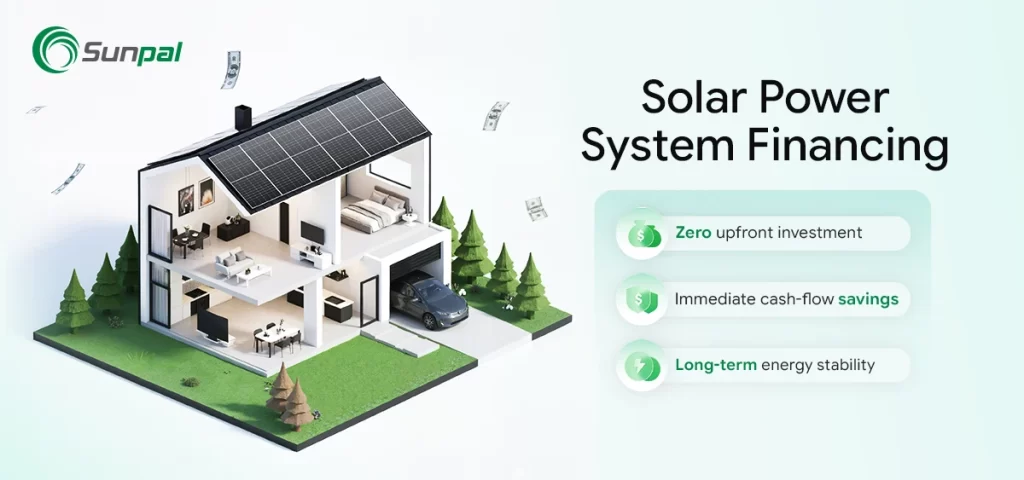
Introduction: Solar Is No Longer a Capital Expense Problem
For years, the biggest barrier to adopting solar energy systems was simple: upfront cost. Today, that barrier is disappearing fast. Thanks to flexible solar power system financing, businesses and homeowners can install photovoltaic (PV) systems with zero upfront investment while reducing electricity bills from the first month.
Instead of asking “Can I afford solar?”, decision-makers are now asking “Why am I still paying full utility rates?”. This shift marks a fundamental change in how solar energy systems are purchased, financed, and valued.
This article explains how zero-upfront solar works, what financing models actually deliver immediate savings, and how to structure a solar PV system that banks approve—and utilities can't compete with.
How Zero-Upfront Solar Financing Actually Works
“Pay nothing upfront” does not mean solar systems are free. It means the system cost is replaced by a predictable monthly payment that is lower than your current electricity expense.
Instead of capital expenditure (CapEx), solar becomes an operational expense (OpEx)—similar to paying for power, but at a locked-in lower rate.
Core Mechanism
- Solar PV system installed with third-party or lender funding
- Monthly payment structured below utility electricity cost
- System generates power immediately after grid connection
- Savings begin in the first billing cycle
This model is now widely used in commercial solar projects, industrial rooftops, and residential PV systems.
Why Lenders Love Solar More Than You Think
Solar energy financing approval rates are rising—not because of incentives alone, but because solar power systems are bankable assets.
Key reasons:
- Predictable energy generation
- Long equipment warranties (25–30 years for modules)
- Stable cash flow from reduced electricity bills
- Rising grid electricity prices strengthen ROI
Chart 1: Electricity Price Growth vs. Solar Power Cost Decline
| Year | Average Grid Electricity Price Index* | Utility-Scale Solar LCOE Index* |
| 2014 | 100 | 100 |
| 2016 | 108 | 78 |
| 2018 | 118 | 60 |
| 2020 | 130 | 48 |
| 2022 | 145 | 38 |
| 2025 (Est.) | 165 | 32 |
The Three Most Used Solar Financing Models (Simplified)
1. Solar Loans – Ownership with Low Entry Cost
Solar loans allow system ownership with minimal or zero upfront payment.
Best for:
- Businesses seeking asset ownership
- Long-term energy cost control
- Users who want tax or depreciation benefits
Key Advantage:
Monthly loan payments are often lower than the previous utility bill, creating positive cash flow.
2. Power Purchase Agreements (PPA) – Pay Only for Energy
Under a PPA, a third party owns the solar system. The user purchases solar electricity at a fixed rate.
Best for:
- Commercial and industrial users
- Companies avoiding balance-sheet assets
- Large rooftops or ground-mounted projects
Key Advantage:
No maintenance responsibility, no capital investment, immediate savings.
3. Solar Leasing – Simplicity and Predictability
Solar leasing offers fixed monthly payments without ownership.
Best for:
- Budget-sensitive users
- Short- to mid-term planning horizons
Key Advantage:
Simple structure and fast deployment.
The Hidden Financing Hacks That Drive Instant Savings
Most solar buyers focus on interest rates. Smart buyers focus on system performance.
Hack #1: High-Efficiency Modules Reduce Financing Risk
Higher efficiency solar panels generate more power per square meter, increasing revenue and lender confidence.
Hack #2: Right-Sized Systems Beat Oversized Systems
Oversizing increases cost without proportional savings. Precision system design improves cash flow metrics.
Hack #3: Smart Inverters Improve Payback
Advanced inverters enhance system stability, monitoring, and grid compliance—key lender concerns.
Chart 2: System Performance vs. Solar Financing Approval Rate
| System Configuration | Average Approval Rate | Typical Payback Period |
| Standard Panels + Basic Inverter | 72% | 7–9 years |
| Tier-1 High-Efficiency Modules | 86% | 5–6 years |
| High-Efficiency + Smart Inverter | 91% | 4–5 years |
| High-Efficiency + Smart Inverter + Monitoring | 96% | 3.5–4.5 years |
How Solar Financing Creates Day-One Savings
A well-structured solar power system financing plan replaces a high utility bill with a lower solar payment.
Example Logic (Simplified):
- Original monthly electricity bill: High and volatile
- Monthly solar payment: Fixed and lower
- Net result: Immediate monthly savings
This is why many solar projects are described as cash-flow-positive from day one.
Commercial & Industrial Solar: Financing at Scale
For factories, warehouses, and logistics centers, solar financing is no longer optional—it's strategic.
Key Business Benefits:
- Energy cost predictability
- Protection against tariff increases
- Improved ESG and sustainability metrics
- No impact on core capital allocation
Chart 3: Commercial Solar Project Cash Flow Timeline
| Project Stage | Timeframe | Financial Impact |
| System Installation | Month 0 | No capital expenditure |
| Grid Connection | Month 1 | Solar generation begins |
| First Utility Bill Offset | Month 1–2 | Immediate cost reduction |
| Cash-Flow Positive Point | Month 6–18 | Solar payments lower than grid bills |
| Break-Even Point | Year 4–6 | Full system cost recovered |
| Net Profit Phase | Year 7–25+ | Long-term energy savings |
Mistakes That Kill Solar Financing Deals
Even strong projects fail when avoidable mistakes are made.
Common Errors:
- Choosing low-quality modules to reduce upfront cost
- Ignoring inverter and battery lifecycle
- Underestimating O&M and monitoring importance
- Designing systems without future expansion in mind
Solar financing rewards long-term reliability, not short-term savings.
Why Equipment Choice Matters More Than Financing Terms
Banks don't finance panels—they finance performance.
That's why bankable solar modules, reliable inverters, and scalable energy storage systems are essential for financing approval.
High-quality equipment:
- Reduces default risk
- Improves project IRR
- Simplifies insurance and compliance
This is where experienced solar solution providers create real value.
How Sunpal Enables Financing-Ready Solar Projects
Sunpal supports solar financing success by delivering bank-approved system configurations, not just equipment.
Sunpal Advantages:
- High-performance solar modules
- Grid-compliant inverters
- Scalable energy storage systems
- Proven global project experience
- Flexible system design for loans, PPAs, and leasing
By aligning technical design with financial requirements, Sunpal helps projects move from approval to operation faster.
The Future: Solar as a Utility Replacement
Solar energy is shifting from a capital purchase to a monthly utility alternative.
As storage, smart EMS, and financing models mature, solar power systems will increasingly replace—not supplement—traditional electricity supply.
The winners will be businesses that act early.
Conclusion: Pay Nothing Upfront, Start Saving Immediately
Zero-upfront solar power systems are no longer a marketing promise—they are a proven financial strategy.
With the right financing model, high-quality equipment, and smart system design, solar energy delivers instant savings, long-term stability, and measurable returns.
Solar is no longer about affordability. It's about opportunity.
Looking to design a financing-ready solar power system? Sunpal's experts are ready to help you turn energy costs into long-term savings.