





Finding a reliable solar system supplier requires buyers to look beyond the information presented in quotations and product catalogs. Specifications, certifications, manufacturing arrangements, and service commitments all provide useful clues about whether a supplier can meet the requirements of a particular order.
However, these details are not always easy to compare. Product specifications may vary between suppliers, certification documents need to be checked for relevance, and quoted prices may not cover the same components or services. Buyers who are still defining their system requirements can also refer to our complete solar power systems for an overview of system configurations, component specifications, and purchasing considerations.
A structured supplier evaluation helps distributors, installers, and project buyers assess these factors before making a purchasing decision. This checklist covers the technical, manufacturing, commercial, and service-related criteria buyers can use to verify supplier capabilities and compare potential partners more effectively.
Why Is a Solar System Supplier Evaluation Checklist Important?
A solar system supplier evaluation checklist creates a repeatable, neutral framework to assess whether a vendor aligns with your project and long-term business goals.
On paper, multiple suppliers may look comparable, but their underlying operational standards, accountability models and ways of fulfilling commitments can differ drastically.
Without a consistent evaluation structure, buyers are vulnerable to avoidable pitfalls:
- Decisions guided by subjective impressions: It is simple to favor a persuasive sales pitch or a low headline price without measuring the full picture of reliability.
- Unbalanced side-by-side comparisons: When you assess vendors informally, you tend to judge each one by different standards, making it impossible to fairly rank competing options.
- Hidden gaps in partnership alignment: You may only discover mismatched expectations after you have committed to an order, creating costly delays and disruptions to your business flow.
- Lack of a defensible audit trail: Informal reviews leave no clear record of your due diligence, which creates extra risk for your internal purchasing team.
A standardized checklist grounds your vendor selection in consistent, objective criteria. It helps you filter out risky partners early, keeps your buying team aligned, and protects your business from costly surprises further down the line.
What Should Buyers Evaluate When Choosing a Solar System Supplier?
A trustworthy solar supplier is more than just a source of low-priced hardware. They need to deliver stable supply, consistent output, clear technical alignment, and reliable support throughout your buying journey. These five review areas help wholesale buyers, distributors and installers make grounded, well-informed partnership decisions.
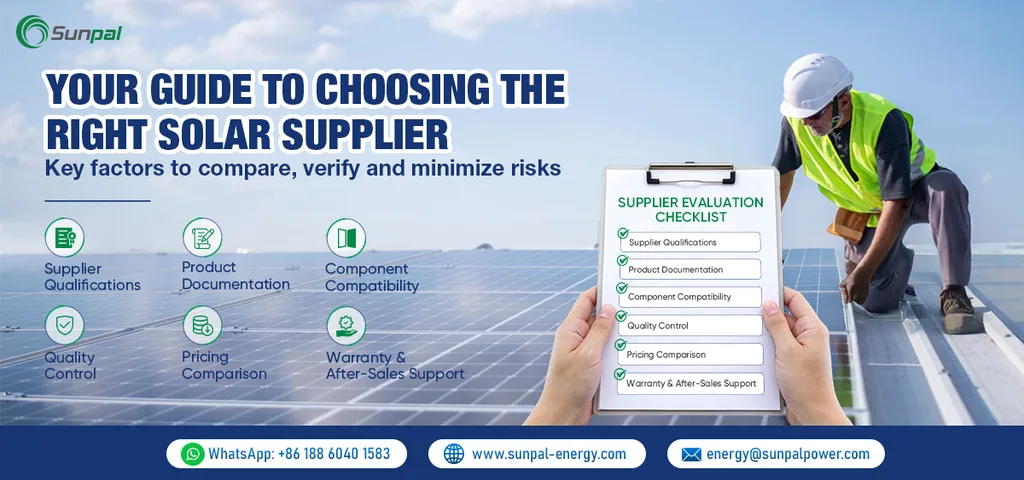
Your Guide to Choosing the Right Solar Supplier
5-step supplier evaluation workflow | Assess qualifications, quality, commercial terms & after-sales to reduce procurement risk for solar wholesale & EPC projects
1. Supplier Qualification Audit Obligatoire
Verify factory credentials, production capacity, export experience and market references.
2. Product Document & Certification Check Obligatoire
Review datasheets, test reports, certificates and system compatibility documentation.
3. On-Site Quality Control Validation Obligatoire
Check EL testing, I-V flash test, batch consistency and pre-shipment inspection rules.
4. Commercial & Lead Time Negotiation Flexible
Confirm MOQ, pricing, Incoterms, stock status and formal payment terms.
5. Warranty & After-Sales Agreement Flexible
Clarify warranty scope, claim process, technical support and spare parts policy.
Multi-Dimension Evaluation
32%
Project claims caused by uncertified PV modules (IRENA)
21%
Hidden crack losses from missing EL inspection (NREL)
47%
Disputes on unclear warranty clauses (SEIA industry survey)
IRENA
International Renewable Energy Agency, global solar industry benchmark data & deployment reports
NREL
National Renewable Energy Laboratory, PV module performance & reliability research
CEI
International Electrotechnical Commission, global PV safety & testing standard framework
SEIA
Solar Energy Industries Association, US solar market guidelines and supplier compliance rules
Supplier Qualifications and Product Supply Setup
Before digging into individual product lines, start by mapping out who you are working with and how their supply chain operates. Not all solar vendors run the same business model. Some own their manufacturing facilities, while others outsource production or stock and resell goods from multiple manufacturers.
You will want to confirm these key points:
- Business registration and valid operating credentials
- In-house manufacturing, distribution or OEM service capability
- Core product portfolio and available model options
- Track record of shipping to your target international markets
- Capacity to handle recurring bulk orders and custom requests
- Past project references and feedback from existing clients
It is critical to separate real operational strengths from marketing language.
For example, a supplier offering a full bundle of panels, inverters and batteries should be able to explain how they source, coordinate and package these items together.
For distributors and installation companies, steady stock availability and the ability to lock in the same specs across repeat orders are especially high priorities.
Technical Documentation and Open Product Disclosure
Clear paperwork is a core marker of a dependable supplier. Every item listed in your quote should have supporting records so you know exactly what you are purchasing.
Reputable suppliers will furnish supporting files for every major part in the package:
- PV module datasheets and electrical specs
- Inverter datasheets and operational parameters
- Battery datasheets and BMS overview
- Relevant certifications and third-party test reports
- Installation and operation guides
- System wiring schematics and configuration notes
- Written warranty terms and service workflows
Do not take broad claims of compliance at face value. Check each certificate one by one: confirm the issuing body, expiry date, matched product model, applicable standards and whether it satisfies requirements for your destination market.
A company-wide certification does not automatically mean every product on your quote meets local regulatory rules.
Also ask for updated documentation whenever the supplier proposes swapping out a component or switching to an alternate model.
Batch Consistency and Incoming Quality Practices
Assess quality standards based on actual inspection workflows, not just marketing descriptions.
Reliable PV manufacturers follow structured testing protocols on the production line. That includes standard flash I‑V curve testing to verify Pmax, Voc and Isc under Standard Test Conditions (1000 W/m², 25 °C, AM 1.5). Acceptable power tolerance should sit within ±3 % of rated capacity, and buyers should expect tight consistency of Voc and Isc across individual modules.
Reputable factories also run two rounds of electroluminescence scanning — dark‑condition infrared inspection both before and after lamination — to spot hidden microcracks, fractured cells and soldering defects that would otherwise be sealed inside finished panels.
For raw materials, reputable factories adopt ISO 2589-1 sampling plans with AQL 1 acceptance criteria for critical components. Special care is also required for moisture-sensitive materials such as EVA film, which must be stored in controlled temperature and humidity environments to avoid delamination down the line.
No matter if the supplier builds gear in their own factory or manages third-party production, you need visibility into how they lock down specs and check quality before shipment.
Key questions to work through:
- Do they run inspections on raw materials and finished goods?
- Are product models and specs traceable through production batches?
- Can they share factory inspection logs and quality check records?
- Are safety and performance tests completed before goods leave the factory?
- Are packaging and shipping arrangements built to protect solar hardware in transit?
- Can they hold identical specs across follow-up orders?
- What is their process for handling defective units and quality complaints?
Batch-to-batch consistency matters enormously for OEM partners and distributors. Silent changes to materials, models or technical specs create headaches for inventory control, field installation and warranty claims down the line.
Make sure any component substitution requires your written approval ahead of time.
When feasible, arrange factory audits or pre-shipment inspections to add an extra layer of confidence before you release an order.
Lead Time, Stock and Commercial Terms
Even a technically solid supplier can be a poor fit if their commercial terms cannot line up with your procurement timeline. Lock in these details before you sign off on an order:
- Minimum order quantity (MOQ)
- Confirmed production lead time
- Current stock status
- Incoterms and destination delivery arrangements
- Packaging and private-label labeling requirements
- Payment terms and schedule
- Access to spare parts
- Protocols for damaged, missing or short-shipped goods
Keep a clear line between estimated production timelines and binding delivery commitments.
For mixed orders with multiple product types, confirm whether the supplier can coordinate production and ship all items together under the agreed schedule.
Get all commercial terms in writing to avoid disputes around payment milestones, shipping responsibility and order adjustments.
Warranty Framework and Long-Term After-Sales Support
Warranty terms should factor into your full partnership evaluation, not treated as an afterthought. A longer warranty window does not equal better service if coverage rules, exclusions and claim workflows are vague. Ask the supplier to spell out:
- Separate warranty periods for each component
- Battery capacity retention thresholds and cycle-life rules
- Conditions that void warranty coverage
- Channels for live technical support
- How replacement parts are sourced and shipped
- Who covers freight and service costs for warranty cases
- What paperwork you need to submit a warranty claim
You also need clarity on how field technical issues get resolved after installation.
For international distributors and installers, responsive communication, easy access to technical files and fast replacement stock are just as valuable as the printed warranty length.
Suppliers that lay out warranty obligations and support steps plainly create a much safer foundation for long-term collaboration.
What Specifications Matter Most When Comparing Solar System Suppliers?
When you receive multiple solar system quotes, surface-level descriptions can look similar. Technical specs give you a measurable way to side-by-side compare offerings and catch hidden gaps that may only show up after installation.
The table below acts as a quick reference sheet to validate the technical details attached to any bundled solar proposal. It focuses on component-level performance metrics and the supporting paperwork you need to confirm the quoted hardware matches what you are buying.
| Composant | Key Specifications to Verify | Supporting Documents |
|---|---|---|
| Modules photovoltaïques | Model, rated power, efficiency, Voc, Isc, Vmp, Imp, dimensions | Module datasheet and applicable certificates |
| Solar inverter | Rated output, maximum PV input, MPPT range, efficiency, grid/off-grid functions | Inverter datasheet and user manual |
| LiFePO4 battery | Nominal voltage, rated capacity, usable energy, charge/discharge current | Battery datasheet and BMS documentation |
| BMS | Protection functions, communication protocol, operating limits | BMS technical documentation |
| Protection devices | DC/AC ratings, isolators, breakers, surge protection | Electrical specifications and relevant test documents |
| Monitoring system | Communication interfaces, monitoring functions, data access | Monitoring manual and compatibility information |
| Complete system | Configuration, BOM, wiring diagram, compatibility, warranty scope | System proposal and technical confirmation |
Buyers should check every specification against the exact product models listed in the quotation rather than relying on headline figures alone. Battery capacity, inverter operating limits, PV module performance, and component compatibility all affect the suitability of the proposed system.
Technical specifications should also be assessed in relation to the intended application. Factors such as local climate, grid requirements, installation conditions, and project load profiles can influence which configuration offers the most practical value.
For buyers assessing ground-mounted solar projects, our guide to ground-mounted solar system selection offers further information on system configurations, component selection, capacity sizing, and purchasing considerations.
How Can Buyers Compare Wholesale Solar System Supplier Quotations?
Structured quotation comparison helps buyers spot meaningful differences that get buried if you only look at the bottom-line price.
Rather than judging offers by the final number alone, buyers need to verify whether suppliers are quoting matching hardware, technical specs, and commercial terms.
Beyond matching the BOM and service scope, buyers can reference a set of standardized engineering benchmarks to filter competitive bids. These hard thresholds help quantify risk before pricing comparison:
| Evaluation Criteria | Target Metric / Benchmark | Risk If Omitted |
|---|---|---|
| Flash Testing Tolerance | ±3% or positive-only power binning | Lower energy yields than modeled in ROI calculations |
| Insulation Resistance | >40 MΩ at 1000V DC (IEC 61730) | Severe fire hazards, electrical faults, and system downtime |
| NOCT/NMOT Range | 42°C - 48°C (Lower is better) | Rapid efficiency drops in hot climates or summer peaks |
| General Liability Limits | Min. 2M occurrence / 4M aggregate (for ~$1M projects) | Corporate exposure to property damage or worker injuries |
| Linear Power Warranty | ≥ 25 Years | Unprotected capital loss if panels degrade prematurely |
Once you identify the preferred supplier, document the agreed quotation, technical requirements, delivery schedule, and responsibilities in the purchase agreement. Record and have both parties approve any changes made during negotiation before production begins. Keeping these details clearly documented helps maintain accountability throughout procurement and reduces the likelihood of misunderstandings during order fulfillment.
What Are the Common Mistakes When Evaluating Solar System Suppliers?
Even seasoned wholesale buyers can fall into predictable mental traps when sourcing solar systems, especially when price or sales messaging drives the final decision. These missteps often do not come from missing a form field, but from flawed assumptions during the review process.
Treating all matching-headline quotes as equal
Buyers often assume offers with the same advertised system size are interchangeable. Suppliers can tweak the underlying bundle to hit a lower price tag while shifting hardware specs or cutting supporting scope.
How to avoid it: Lock in a fixed baseline scope before opening bidding, so every quote is built against the same set of ground rules.
Assuming advertised specs guarantee system interoperability
It is easy to take compatibility for granted when two parts look like they belong together on paper. Minor differences in communication logic or operating thresholds can still break system performance.
How to avoid it: Do not rely on general product descriptions. Ask for a formal compatibility sign-off tied to the exact part numbers in your quote.
Treating a supplier’s brand reputation as proof of compliance
A well-known brand or company-level certification does not mean every listed component automatically meets your target market’s rules.
How to avoid it: Separate brand credibility from model-specific compliance proof for your project.
Judging quality only by marketing copy
Many buyers stop at reviewing product brochures, without confirming how consistency is maintained across batches. How to avoid it: Look for evidence of repeatable quality workflows, not just promotional claims.
Chasing the longest warranty term without reading the fine print
A lengthy warranty headline means very little if the claim rules, cost allocation and exclusions are loosely defined.
How to avoid it: Evaluate the practical enforceability of warranty terms, not just the number of years printed on the spec sheet.
Accepting informal timelines as binding delivery promises
Verbal or rough lead-time estimates often leave room for shifting priorities and unplanned delays.
How to avoid it: Distinguish between rough projections and formal, written delivery commitments before committing to the order.
Making a Confident Solar Supplier Selection
Choosing the right solar supplier goes far beyond checking price tags or skimming product catalogs. Buyers need to weigh all evidence gathered during their full‑scope evaluation: business qualifications, complete technical documentation, cross‑component compatibility, established quality‑control workflows, confirmed delivery timelines, and formal after‑sales commitments.
A vendor with attractive pricing can still carry significant downstream risks if they cannot furnish proper documentation or solid warranty frameworks. Judging every supplier against the same set of objective criteria helps buyers spot red flags, separate real‑world capabilities from marketing language, and arrive at well‑grounded procurement decisions.
For buyers considering SUNPAL as a potential supply partner, reviewing relevant company information and discussing specific sourcing requirements can help clarify whether the available solutions and support arrangements meet their expectations.
Frequently Asked Questions About Solar System Supplier Evaluation
What Should Buyers Check Before Choosing a Solar System Supplier?
Buyers should audit 8 core criteria beyond price: Tier-1 manufacturing capacity (5GW+), complete IEC/UL certificates, PV-Inverter-BESS compatibility, Triple-Stage EL quality control, 15–20-day 40HQ lead times, reinsured 25–30-year warranties, bankability credentials, and 24/7 technical support.
Which Documents Should a Solar System Supplier Provide?
A qualified supplier must provide a serial-matched technical package: PV/Inverter/BESS datasheets, BMS protocol maps (CAN/RS485), IEC 61215/61730 & UL 9540A certificates, serial-matched Flash-Test reports, Single-Line Diagrams (SLD), CAD layouts, and written 25–30-year warranty terms.
How Can Buyers Verify Solar Panel, Inverter, and Battery Compatibility?
Verify 5 critical electrical & communication parameters: Array Vₒc vs. inverter MPPT voltage window, String Iₘₚ vs. MPPT current limits, 48V LV vs. High-Voltage battery architecture, Continuous C-rate (0.5C/1C), and Native CANbus/RS485 BMS protocol handshake.
How Can Buyers Evaluate the Quality of a Solar System Supplier?
Audit 4 measurable factory quality benchmarks: Triple-Stage EL testing (pre/post-lamination & pre-packing) to guarantee zero micro-cracks, Class AAA flash testing with 0 to +5W positive power tolerance, IQC raw material inspections, and Support for third-party FAT audits (SGS/TÜV/Intertek).
What Should Buyers Compare When Reviewing Wholesale Solar System Quotations?
Normalize wholesale quotations across 6 line items: Exact Bill of Materials (cell & inverter brands), net usable kWh capacity, Incoterms (CIF/DDP with 110% cargo insurance), container loading density, grid compliance (VDE/G99/UL 1741 SB), and inclusion of 1%–2% spare parts buffer kits.
What Should Be Included in a Solar System Warranty?
Ensure 5 quantitative warranty parameters: 30-year PV linear performance (≥87.4%–88.85% output), battery cycle life (≥6,000–8,000 cycles at 80% DoD), third-party reinsurance backstop, defined 7–14 day RMA replacement SLAs, and supplier-covered replacement freight.
Why Is After-Sales Support Important When Selecting a Solar Supplier?
Effective after-sales support minimizes system downtime and protects project ROI. Key services include 24/7 IoT cloud diagnostics, remote BMS/PCS firmware updates, <24-hour SLA helpdesk responses, localized commissioning guidance, and on-hand container spare parts buffer kits.