


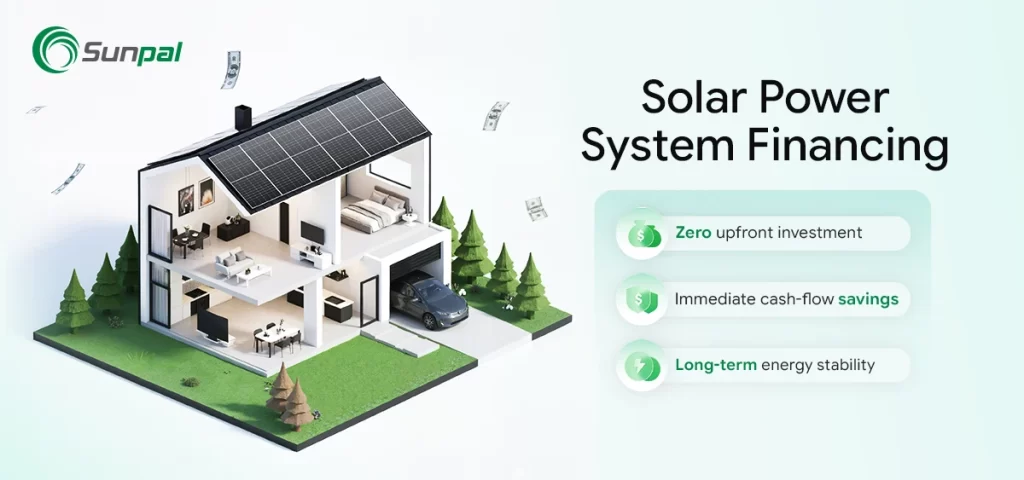
Introduction : Le solaire n'est plus un problème de dépenses d'investissement
Pendant des années, le principal obstacle à l'adoption de la systèmes d'énergie solaire était simple : le coût initial. Aujourd'hui, cet obstacle disparaît rapidement. Grâce au financement flexible des systèmes d'énergie solaire, les entreprises et les particuliers peuvent installer des systèmes photovoltaïques (PV) sans investissement initial, tout en réduisant leurs factures d'électricité dès le premier mois.
Au lieu de se demander “Ai-je les moyens d'acheter de l'énergie solaire ?”, les décideurs se demandent maintenant “Pourquoi dois-je encore payer le plein tarif de mon fournisseur d'électricité ? Cette évolution marque un changement fondamental dans la manière dont les systèmes d'énergie solaire sont achetés, financés et évalués.
Cet article explique comment fonctionne l'énergie solaire sans apport initial, quels sont les modèles de financement qui permettent de réaliser des économies immédiates et comment structurer un système photovoltaïque que les banques approuvent et avec lequel les compagnies d'électricité ne peuvent pas rivaliser.
Comment fonctionne le financement solaire sans apport initial ?
“Ne rien payer à l'avance” ne signifie pas que les systèmes solaires sont gratuits. Cela signifie que le coût du système est remplacé par un paiement mensuel prévisible qui est inférieur à votre dépense d'électricité actuelle.
Au lieu d'une dépense d'investissement (CapEx), l'énergie solaire devient une dépense opérationnelle (OpEx) - semblable au paiement de l'électricité, mais à un tarif inférieur bloqué.
Mécanisme de base
- Système photovoltaïque installé grâce à un financement par un tiers ou un prêteur
- Paiement mensuel inférieur au coût de l'électricité
- Le système produit de l'électricité immédiatement après le raccordement au réseau
- Les économies commencent dès le premier cycle de facturation
Ce modèle est aujourd'hui largement utilisé dans les projets solaires commerciaux, les toits industriels et les systèmes photovoltaïques résidentiels.
Pourquoi les prêteurs aiment le solaire plus que vous ne le pensez
Les taux d'approbation du financement de l'énergie solaire augmentent, non seulement en raison des mesures incitatives, mais aussi parce que les systèmes d'énergie solaire sont des actifs bancables.
Raisons principales :
- Une production d'énergie prévisible
- Longues garanties sur les équipements (25-30 ans pour les modules)
- Flux de trésorerie stable grâce à la réduction des factures d'électricité
- La hausse des prix de l'électricité renforce le retour sur investissement
Graphique 1 : Croissance des prix de l'électricité et baisse des coûts de l'énergie solaire
| Année | Indice moyen des prix de l'électricité sur le réseau* | Indice LCOE de l'énergie solaire à l'échelle du réseau* |
| 2014 | 100 | 100 |
| 2016 | 108 | 78 |
| 2018 | 118 | 60 |
| 2020 | 130 | 48 |
| 2022 | 145 | 38 |
| 2025 (estimation) | 165 | 32 |
Les trois modèles de financement solaire les plus utilisés (simplifiés)
1. Prêts solaires - Une propriété à faible coût d'entrée
Les prêts solaires permettent de devenir propriétaire du système avec un paiement initial minime ou nul.
Meilleur pour :
- Entreprises à la recherche d'une propriété d'actifs
- Maîtrise des coûts énergétiques à long terme
- Les utilisateurs qui souhaitent bénéficier d'avantages fiscaux ou d'amortissement
Avantage principal :
Les mensualités du prêt sont souvent inférieures à la facture d'électricité précédente, ce qui crée un flux de trésorerie positif.
2. Accords d'achat d'électricité (AAE) - Ne payer que pour l'énergie
Dans le cadre d'un contrat d'achat d'électricité, un tiers est propriétaire du système solaire. L'utilisateur achète l'électricité solaire à un tarif fixe.
Meilleur pour :
- Utilisateurs commerciaux et industriels
- Les entreprises évitent les actifs du bilan
- Grandes toitures ou projets au sol
Avantage principal :
Pas de responsabilité de maintenance, pas d'investissement en capital, des économies immédiates.
3. Leasing solaire - Simplicité et prévisibilité
Le leasing solaire permet de payer des mensualités fixes sans être propriétaire.
Meilleur pour :
- Utilisateurs sensibles au budget
- Horizons de planification à court et moyen terme
Avantage principal :
Structure simple et déploiement rapide.
Les astuces de financement cachées qui permettent de réaliser des économies instantanées
La plupart des acheteurs d'énergie solaire se concentrent sur les taux d'intérêt. Les acheteurs avisés se concentrent sur les performances du système.
Hack #1 : les modules à haut rendement réduisent le risque de financement
Efficacité accrue panneaux solaires produisent plus d'énergie par mètre carré, augmentant ainsi les revenus et la confiance des prêteurs.
Hack #2 : Les systèmes bien dimensionnés l'emportent sur les systèmes surdimensionnés
Le surdimensionnement augmente les coûts sans entraîner d'économies proportionnelles. La conception de systèmes de précision améliore les flux de trésorerie.
Hack #3 : Les onduleurs intelligents améliorent le retour sur investissement
Les onduleurs avancés améliorent la stabilité du système, la surveillance et la conformité du réseau - des préoccupations essentielles des prêteurs.
Graphique 2 : Performance du système par rapport au taux d'approbation du financement solaire
| Configuration du système | Taux d'approbation moyen | Période de récupération typique |
| Panneaux standard + onduleur de base | 72% | 7-9 ans |
| Modules à haut rendement de niveau 1 | 86% | 5-6 ans |
| Haute efficacité + Onduleur intelligent | 91% | 4-5 ans |
| Haute efficacité + onduleur intelligent + surveillance | 96% | 3,5-4,5 ans |
Comment le financement de l'énergie solaire permet de réaliser des économies dès le premier jour
Un plan de financement de système d'énergie solaire bien structuré remplace une facture d'électricité élevée par un paiement solaire moins élevé.
Exemple logique (simplifié) :
- Facture mensuelle originale d'électricité : Élevée et volatile
- Paiement mensuel de l'énergie solaire : Fixe et moins élevé
- Résultat net : Des économies mensuelles immédiates
C'est pourquoi de nombreux projets solaires sont décrits comme ayant un flux de trésorerie positif dès le premier jour.
Solaire commercial et industriel : Financement à l'échelle
Pour les usines, les entrepôts et les centres logistiques, le financement de l'énergie solaire n'est plus facultatif, il est stratégique.
Principaux avantages pour les entreprises :
- Prévisibilité du coût de l'énergie
- Protection contre les augmentations tarifaires
- Amélioration des indicateurs ESG et de durabilité
- Pas d'impact sur l'allocation du capital de base
Graphique 3 : Calendrier des flux de trésorerie d'un projet solaire commercial
| Stade du projet | Cadre temporel | Impact financier |
| Installation du système | Mois 0 | Pas de dépenses en capital |
| Connexion au réseau | Mois 1 | Début de la production solaire |
| Première compensation de la facture d'électricité | Mois 1-2 | Réduction immédiate des coûts |
| Point positif du cash-flow | Mois 6-18 | Les paiements solaires sont moins élevés que les factures du réseau |
| Point mort | Année 4-6 | Recouvrement de l'intégralité des coûts du système |
| Phase de profit net | Année 7-25+ | Économies d'énergie à long terme |
Les erreurs qui tuent les contrats de financement de l'énergie solaire
Même les projets solides échouent lorsque des erreurs évitables sont commises.
Erreurs courantes :
- Choisir des modules de faible qualité pour réduire le coût initial
- Ignorer le cycle de vie de l'onduleur et de la batterie
- Sous-estimation de l'importance de l'O&M et du suivi
- Concevoir des systèmes sans tenir compte des extensions futures
Le financement de l'énergie solaire récompense la fiabilité à long terme, et non les économies à court terme.
Pourquoi le choix de l'équipement importe-t-il plus que les conditions de financement ?
Les banques ne financent pas les panels, elles financent la performance.
C'est pourquoi des modules solaires bancables, des onduleurs fiables et des systèmes de stockage d'énergie évolutifs sont essentiels pour l'obtention d'un financement.
Un équipement de haute qualité :
- Réduit le risque de défaillance
- Améliore le TRI du projet
- Simplification de l'assurance et de la conformité
C'est là que les fournisseurs de solutions solaires expérimentés créent une véritable valeur ajoutée.
Comment Sunpal permet aux projets solaires d'être prêts à être financés
Sunpal favorise le succès du financement solaire en fournissant des configurations de systèmes approuvées par les banques, et pas seulement des équipements.
Avantages de Sunpal :
- Modules solaires à haute performance
- Onduleurs compatibles avec le réseau
- Systèmes de stockage d'énergie évolutifs
- Expérience avérée en matière de projets internationaux
- Conception flexible du système pour les prêts, les AAE et le crédit-bail
En alignant la conception technique sur les exigences financières, Sunpal aide les projets à passer plus rapidement de l'approbation à l'exploitation.
L'avenir : Le solaire comme substitut des services publics
L'énergie solaire est en train de passer d'un achat de capital à une alternative de service public mensuel.
Au fur et à mesure que le stockage, les systèmes intelligents de gestion de l'énergie et les modèles de financement se développent, les systèmes d'énergie solaire remplaceront de plus en plus l'approvisionnement traditionnel en électricité, sans pour autant le compléter.
Les gagnants seront les entreprises qui agiront tôt.
Conclusion : Ne rien payer d'avance, commencer à épargner immédiatement
Les systèmes d'énergie solaire sans mise de fonds initiale ne sont plus une promesse commerciale, mais une stratégie financière qui a fait ses preuves.
Avec le bon modèle de financement, un équipement de haute qualité et une conception intelligente du système, l'énergie solaire permet des économies instantanées, une stabilité à long terme et des rendements mesurables.
L'énergie solaire n'est plus une question d'accessibilité. C'est une question d'opportunité.
Vous cherchez à concevoir un système d'énergie solaire prêt à être financé ? Les experts de Sunpal sont prêts à vous aider à transformer les coûts énergétiques en économies à long terme..